


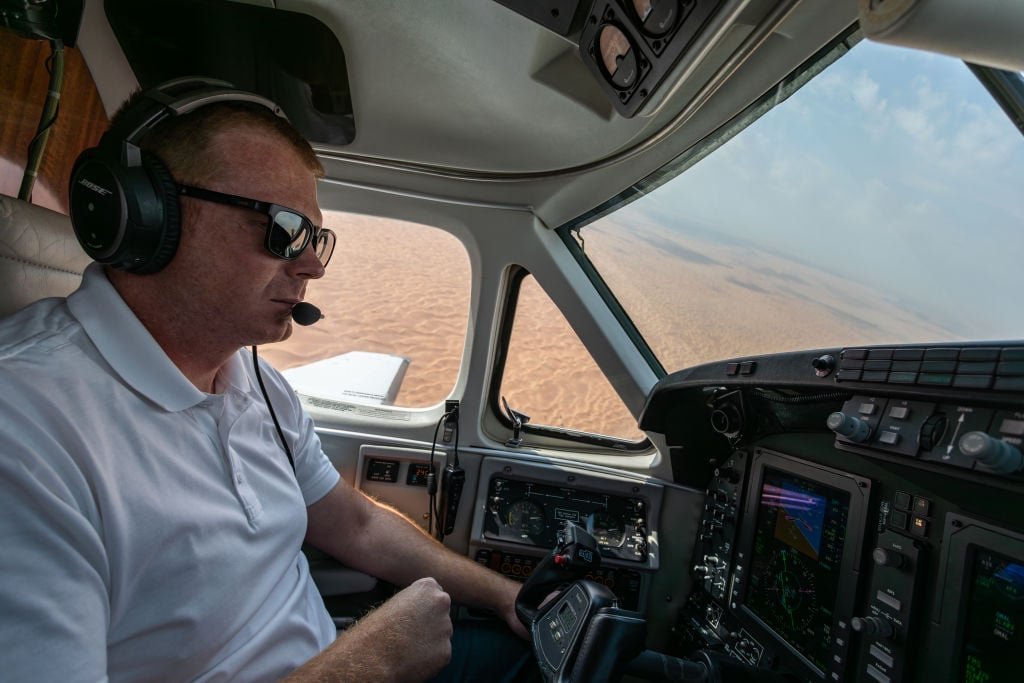

Preparations for cloud seeding during the winter season in the UAE are coming into sharp focus, as the country continues to strengthen its state-of-the-art meteorological capabilities.
Earlier this month, H.H. Sheikh Mansour bin Zayed Al Nahyan, vice president, deputy prime minister, and chairman of the Presidential Court, visited the National Centre of Meteorology (NCM) headquarters in Abu Dhabi.
He was briefed on the centre’s advanced infrastructure, including weather forecasting units, cloud seeding systems, marine monitoring operations, and renewable energy forecasting sections (WAM).
The NCM’s work is underpinned by one of the region’s most advanced supercomputers, which enables high-precision numerical weather prediction and improves early warning capabilities. Sheikh Mansour also reviewed the “Early Warning for All” platform, which provides real-time alerts to UAE citizens abroad during extreme weather events, and the NCM’s Science Dome, designed to raise public climate awareness.
Alongside these capabilities, the NCM runs one of the world’s most active rain enhancement programmes. The UAE has carried out 185 cloud seeding missions so far in 2025, including 39 in July alone, according to NCM data.
Using hygroscopic flares, nanomaterials, and electric-charge emitters, these flights aim to increase rainfall by 10 to 25 per cent under favourable conditions.

Research in npj Climate and Atmospheric Science estimates the programme generates 168–838 million cubic metres of additional rainfall annually, with 84–419 million cubic metres of usable water. A separate evaluation on ResearchGate found an average 23 per cent increase in annual surface rainfall over seeded areas compared to the pre-seeding era. The UAE spends about Dhs29,000 per flight hour, with more than 900 hours of missions conducted each year.

“Rainfall enhancement has historically been overlooked as a key component of sustainability and climate change adaptation strategies,” the authors of the npj report note.
Each mission can last up to three hours, with pilots circling the base of cumulus clouds and releasing salt particles from flares when updrafts are detected. The fleet comprises four dedicated aircraft and 12 specially trained pilots. The NCM says the materials used are harmless, relying on natural salts such as potassium chloride and sodium chloride.
The UAE now has more than 60 networked weather stations, an integrated radar network, and the Emirates Weather Enhancement Factory — the region’s first facility for producing high-quality flares. The government has also invested $20m in cloud seeding research and development, according to a recent CNBC report.
Cloud seeding in coming days?
The NCM forecasts partly cloudy to cloudy skies in the eastern and southern regions this weekend, with a chance of light rain despite daytime highs reaching 46°C in some areas.
The outlook follows recent moderate to heavy rainfall, dust storms, and cooler temperatures in parts of Abu Dhabi and Dubai.
#المركز_الوطني_للأرصاد #الإمارات_العربية_المتحدة #حالة_الطقس #أمطار #ضباب #حالة_البحر #سرعة_الرياح #إتجاه_الرياح#NCM #UAE #officialuaeweather #weatherforecast pic.twitter.com/jVbdyPBso4
— المركز الوطني للأرصاد (@ncmuae) August 14, 2025
With the UAE’s annual rainfall averaging just 6.7 billion cubic metres, officials say the cloud seeding programme remains a vital part of the nation’s water security strategy.
Pictured below are images from a cloud seeding mission that took place in January 2024.


