


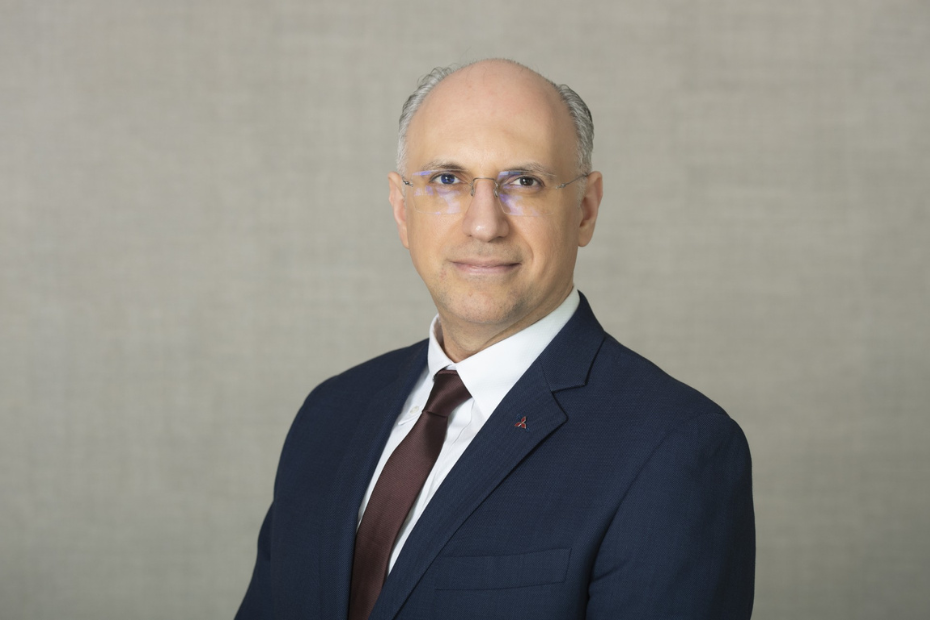

Khalid Salem, president for the Middle East & North Africa at Mitsubishi Power/Image: Supplied
The Middle East is accelerating investment in artificial intelligence (AI), hyperscale data centres, and digital megaprojects, creating an unprecedented surge in electricity demand. Khalid Salem, president for the Middle East & North Africa at Mitsubishi Power, spoke with us about how utilities and governments are preparing to meet this growth, the role of gas and hydrogen in the transition, and what a zero-ready energy system could look like.
Meeting exponential demand
“Energy demand is growing everywhere – after all we’re now living through the electrification of everything,” Salem said. “In the Middle East and North Africa (MENA), we are already seeing demand rise faster than ever, driven by growing population, economic boom, and to support the national developments plans drawn by countries, especially in the GCC.”
That baseline challenge has been amplified by a rapid rise in AI adoption and data centre development. “The International Energy Agency says the region’s power demand could double by 2030, which is a huge jump,” he added. “The core challenge in the UAE and the wider region has long been how to secure energy for the needs of today and tomorrow. This means ensuring enough and uninterrupted power supply while also meeting national sustainability targets on carbon emissions.”
IEA projections show global electricity usage from data centres reaching nearly 945 TWh by 2030, and the Middle East is emerging as a hotspot. “The Middle East is steadily positioning itself as a global data centre hub,” Salem noted. “IEA projects the region’s installed data centre capacity to almost triple to around 3.3 GW over the next five years. This will inevitably put greater demands on our power systems.”
Countries such as Saudi Arabia and the UAE are leading the way with large-scale expansion plans in which gas will continue to play a central role in the energy mix. “Our power systems must integrate new, intermittent and distributed sources of supply while balancing this supply with variable demand – it’s no easy task but the entire industry is straining every sinew to make it happen,” Salem said.
GCC grids under transformation
Asked whether national grids are equipped to handle smart city infrastructure, AI workloads, and peak loads, Salem said the sector is undergoing a deep transformation. “Power grids across the GCC are undergoing a transformational shift by unlocking new opportunities while navigating the challenges that come with rapid growth. The focus now is on building infrastructure, technologies, and partnerships necessary to meet soaring demand.”
Gas, he emphasised, remains the bedrock. “Across the GCC, gas provides the baseload, dispatchable power that is needed to respond to this growing but variable demand and will continue to do so for the foreseeable future.”
Reducing emissions without compromising reliability remains a balancing act. “Leaders and policymakers across the region have recognised the need to reduce emissions, evidenced in the national energy strategies in several MENA countries,” Salem explained. “However, this transition must be pragmatic: the black out in Spain this year was a stark reminder of the human and economic cost when power grids fail.”
He added: “Reducing emissions must go hand-in-hand with ensuring reliable power supply. That means taking a balanced approach where all technologies work together with gas playing a key role in ensuring energy security.”
Gas as the bridge fuel
For Mitsubishi Power, advanced gas turbine projects are central to this approach. “Gas is the bridge fuel in the energy transition. It’s more efficient and produces fewer emissions than heavy fuel oil and not only that, it is actually enabling the integration of new renewables by providing the base load, stability and inertia that intermittent renewables cannot.”
He pointed to several examples. In Saudi Arabia, Mitsubishi Power is supplying six state-of-the-art M501JAC gas turbines for the 3.6 GW Rumah-1 and Al-Nairyah-1 power plants. In the UAE, the company is helping power the future with the 2.4 GW Fujairah F3 GTCC plant, which will provide hydrogen-ready electricity to around 380,000 households. And in Bahrain, Mitsubishi Power recently delivered its hydrogen-ready M701JAC gas and steam turbines, producing 680.9 MW of on-site power generation for Aluminium Bahrain (Alba).
Read: Mitsubishi Power, ANRPC complete MENA’s first hydrogen boiler retrofit
Looking ahead, Salem sees hydrogen as critical to the sector’s decarbonisation. “Countries like the UAE, Oman, and Saudi Arabia have developed national hydrogen strategies and are emerging as global leaders in the space. At COP28 in Dubai, over 30 countries joined the Declaration of Intent on Hydrogen, aiming to accelerate hydrogen commercialisation.”
“In the short term, blending hydrogen with gas offers immediate benefits in terms of reducing emissions,” he explained. “All Mitsubishi Power turbines delivering across the region are hydrogen-ready and designed to enhance grid stability with renewables integration.”
Examples are already in play. In Morocco, Mitsubishi Power is supplying two M701JAC gas turbines for the Al Wahda Open Cycle Gas Turbine Power Plant. This peaker facility will help balance the country’s growing renewable energy resources by offering rapid response to grid fluctuations and ensuring a stable power supply.
“Our advanced gas turbines are engineered to co-fire hydrogen today, with a clear roadmap toward 100 per cent hydrogen combustion,” Salem said. “Ultimately, our approach enables a pragmatic pathway to a low carbon world, which leverages new and existing infrastructure to deliver a cleaner, more flexible energy future.”
Trials abroad reinforce this direction. “We recently successfully completed a second trial blending 50 per cent hydrogen and natural gas at Georgia Power’s Plant McDonough-Atkinson in Smyrna, Georgia and have also demonstrated 100 per cent hydrogen firing at our Takasago Hydrogen Park.”
Investment momentum
Salem confirmed that governments and private operators are increasing investment in turbine solutions. “There has indeed been an increased investment in gas turbines across the region, driven by the need for uninterrupted power generation to meet rising electricity demand, while delivering on long-term decarbonisation goals.”
National hydrogen strategies, clean fuel targets, and incentives are all helping accelerate this.
Asked how Saudi Arabia and the UAE can support digital megaprojects without straining sustainability or affordability, Salem pointed to hybrid energy models. “Both countries must continue investing in hybrid energy models that integrate renewables, lower emissions dispatchable power, long-duration storage, and hydrogen infrastructure.”
Localisation is also critical. Mitsubishi Power’s gas turbine assembly facility in Dammam not only supports Saudi Arabia’s localisation drive but also acts as a hub for technical training and workforce development. Today, over half of Mitsubishi Power’s workforce in Saudi Arabia is composed of Saudi nationals, a fact that Salem links to national ambitions in AI and data centre expansion.
Toward a zero-ready system
Finally, Salem described what a zero-ready system could look like: “Countries like the UAE and Saudi Arabia face several challenges as they work to build their net-zero-ready energy systems. These systems must deliver reliable, resilient power with the flexibility to meet fast-growing demand, while also advancing national goals around decarbonisation and energy leadership.”
“Mitsubishi Power is helping bring this vision to life by providing the technologies and partnerships that help meet demand while developing clean, secure, and future-ready energy systems for tomorrow.”
He added: “This direction is aligned with our own goals at Mitsubishi Heavy Industries (MHI) under ‘Mission Net Zero’, through which MHI has committed to cutting CO₂ emissions from its operations by 50 per cent by 2030 (compared to 2014), and to achieve net-zero emissions across its entire value chain, including customer use of our technologies by 2040.”
