


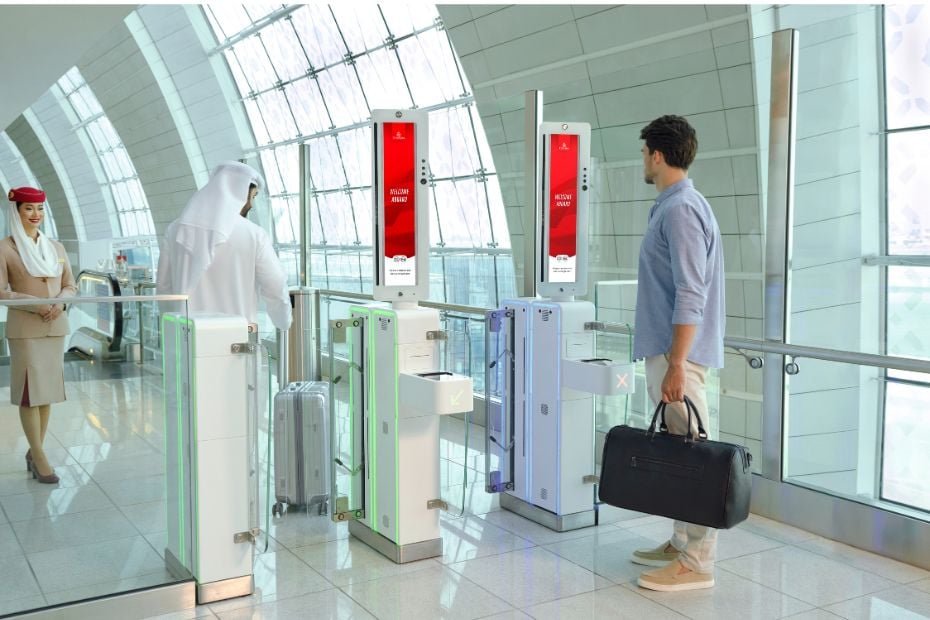

Image credit: Emirates/Website
Emirates has made a bold move toward a fully contactless travel experience with an Dhs85m investment to install more than 200 biometrics-enabled cameras across Terminal 3 at Dubai International Airport (DXB). The airline says the rollout will allow passengers to pass through check-in, immigration, boarding gates, and lounges using only facial recognition, eliminating the need to repeatedly present passports or boarding passes.
The initiative, developed in collaboration with the General Directorate of Identity and Foreigner Affairs Dubai (GDRFAD), marks a major step forward in Emirates’ long-term vision to deliver a seamless, high-tech airport journey, an Emirates media report said.
“With our latest Biometrics Path development, Emirates has invested in further innovations to enhance the customer travel experience, providing remarkable speed, efficiency, and accuracy at Terminal 3,” said Adel Al Redha, Emirates’ deputy president and COO. “Since 2017, we have been working in collaboration with GDRFAD to upgrade our equipment and implement the latest technologies, ensuring that our customers enjoy a world-class, seamless journey.”
The newly installed cameras can recognise a passenger’s biometric profile from a distance of one metre, allowing for continuous movement through the airport. Emirates says the technology significantly reduces processing times, enabling passengers to walk through formerly time-consuming checkpoints without interruption.
Whether visitors or residents, any Emirates customer can register for the biometric system via the Emirates app, self-service kiosks, or check-in counters. Once registered, they can access dedicated biometric zones every time they fly to or from Dubai, bypassing queues and document checks.
Lieutenant General Mohammed Ahmed Al Marri, director general of GDRFAD Dubai, said the partnership reflects the emirate’s commitment to integrating innovation into everyday travel.
“At GDRFA Dubai, innovation has long been part of our DNA,” he said. “Over the years, we have integrated artificial intelligence and biometric technologies to make travel through Dubai faster, safer, and more intuitive. Together with Emirates, we are shaping a seamless travel experience that embodies the UAE’s reputation for efficiency, hospitality, and digital governance.”

How customers can use Emirates Biometrics at DXB
Step 1: Register
Customers can sign up using the Emirates app or at check-in desks in Dubai. Registration is open to travelers aged 18 and above, each of whom must register individually. On the Emirates app, the process takes just a few minutes, members of Emirates Skywards simply scan their passport, ensure the details match their profile, and provide consent for Emirates to use the biometric data stored in the GDRFAD database.
Step 2: Biometric check-in
Once registered, travelers can use facial recognition to check in at kiosks. Emirates says biometric check-in at transfer connections will be available soon.
Step 3: Fast-track through Smart Gates
Passengers can use GDRFAD-managed Smart Gates at Emirates Terminal 3 to bypass immigration queues during arrivals and departures. The process takes only seconds: step into the Smart Gate, pose for a quick photo, and proceed to baggage claim or security. UAE citizens, residents, GCC nationals, and visa-on-arrival visitors with biometric passports are eligible.
Step 4: Biometric entry to the Emirates Lounge
Eligible customers with lounge access can now enter the Emirates Lounge at Concourse B through facial recognition at five entry points, no boarding pass required. Once inside, travelers enjoy chef-crafted dining and luxury amenities in line with Emirates’ premium standards.
Step 5: Biometric boarding
At select departure gates across Concourses A, B, and C, passengers can now board via biometric recognition instead of scanning boarding passes. Emirates plans to expand the system across additional gates soon.
Behind the technology: Creating the GDRFAD digital profile
When customers register, Emirates matches their facial image against their existing GDRFAD biometric record, if available. For those without one, the airline creates a temporary biometric profile that captures consent for Emirates Biometrics. Once the traveler enters Dubai, this temporary record converts into a full GDRFAD profile, a digital identity managed by GDRFAD that enables access to services like Smart Gates at DXB.
A GDRFAD profile forms the backbone of Emirates’ contactless journey, enabling travelers to move through the airport more efficiently with secure, AI-powered identity verification.
Emirates’ biometric system operates through close integration with GDRFAD’s extensive identity database. When a traveler registers, Emirates securely matches their facial image with GDRFAD’s existing biometric records.
For new visitors to Dubai, a temporary biometric profile is created to store consent for Emirates Biometrics. Once they pass through Dubai immigration, this record is automatically upgraded to a permanent GDRFAD profile, ready for use in future trips.
The biometric data supports functions such as automated check-in, security clearance, boarding, and lounge access, transforming what was once a paper-based process into a fully digital, contactless experience.
What information Emirates collects and how it’s secured
For the purpose of identification and authentication at biometric touchpoints, Emirates processes several categories of data, including:
- Facial features and images
- Personal information from the flight booking
- Data collected during check-in
- Emirates Skywards profile details
The airline emphasizes that data protection and security are central to its biometrics program.
Emirates maintains “appropriate technical and organisational security measures” to safeguard personal data, including biometric information, in accordance with its privacy policy. The security of data stored with GDRFAD is governed by the authority’s own digital governance and security frameworks.
“Emirates implements and maintains strict security measures, policies, and procedures designed to protect personal information, including biometrics,” the airline said. “The security of biometric data with GDRFAD is subject to GDRFAD’s policies and practices.”
A step toward the future of global aviation
Industry analysts say Emirates’ biometric expansion underscores a wider global shift toward automation and smart travel. As airports increasingly invest in artificial intelligence, facial recognition, and cloud-based identity systems, airlines are racing to deliver faster, more secure, and paperless journeys.
For Emirates, which handles tens of millions of passengers annually through DXB, one of the world’s busiest international hubs, the biometrics rollout marks a strategic milestone in operational efficiency and customer satisfaction.
The investment also aligns with Dubai’s broader ambition to cement its status as a global leader in digital transformation and smart governance. The collaboration between Emirates and GDRFAD exemplifies the synergy between the UAE’s public and private sectors, a hallmark of Dubai’s innovation-driven economy.
From check-in to boarding, Emirates’ new biometrics initiative signals a reimagined airport journey, one where passengers can move freely and swiftly, guided by technology that recognizes them instantly.
For travelers, it means less time waiting in queues and more time enjoying the Emirates experience. For the airline, it represents a forward-looking investment in operational excellence and customer trust.
As Al Redha put it, the future of travel through Dubai International is now “swift, secure, and seamless.”
