


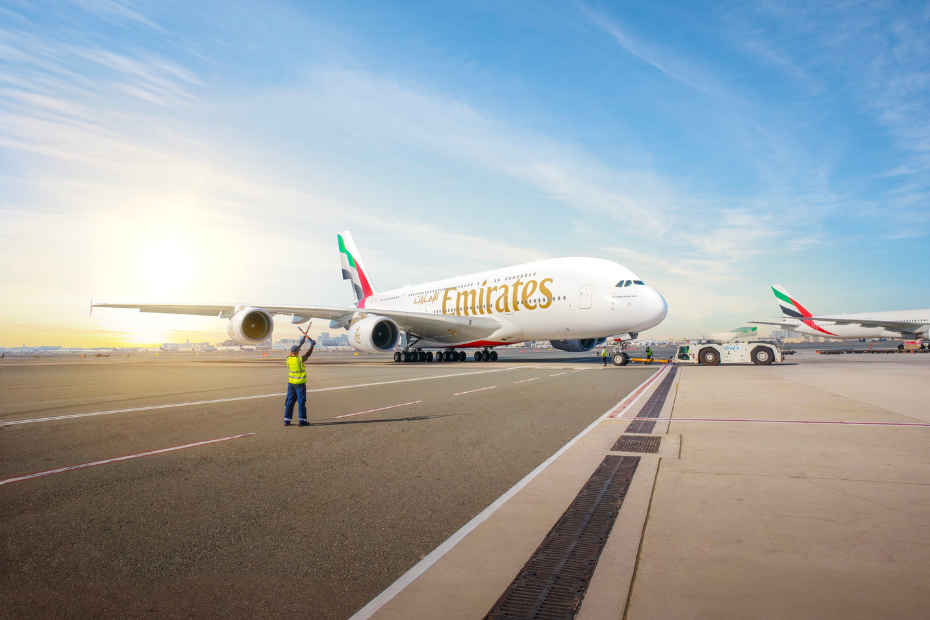

Image: Supplied
The Emirates Group has reported a record-breaking performance for the first half of the 2025–26 financial year, achieving its fourth consecutive half-year of record profitability, with a profit before tax of Dhs12.2bn ($3.3bn). This marks a 13 per cent increase in profit after tax, reaching Dhs10.6bn ($2.9bn) compared to the same period last year.
Group revenue rose 4 per cent to Dhs75.4bn ($20.6bn), supported by robust global demand for air travel and logistics services. The Group also reported a strong EBITDA of Dhs21.1bn ($5.7bn), up from Dhs20.4bn ($5.6bn) in the previous year, reflecting its sustained operational resilience.
As of 30 September 2025, the Emirates Group held a record cash balance of Dhs56bn ($15.2bn), compared to Dhs53.4bn ($14.6bn) on 31 March 2025. The Group continued to use its robust liquidity to fund new aircraft deliveries, service debt, and pay the remaining AED 2 billion (US$ 545 million) dividend declared for FY2024–25.
His Highness Sheikh Ahmed bin Saeed Al Maktoum, Chairman and Chief Executive of Emirates Airline and Group, said: “The Group has once again delivered an outstanding performance, surpassing our half-year results of last year to achieve a new record profit for H1 2025-26. I’m delighted to note that Emirates maintains its position as the world’s most profitable airline for this half-year reporting period.
“This performance was primarily driven by the unflagging demand and growing customer preference for our product and services, which drove revenue growth and profitability.
“Emirates and dnata have invested billions to continually enhance our products and services, to bring new products to market, to improve our operations through innovation and technology, and to look after our employees who ensure our customers’ safety and satisfaction. These are core to our DNA.
“The Group’s strong profitability enables us to continue making these investments, and to scale up our proven business models in concert with Dubai’s growth as a global city of choice for talent, for businesses, and for tourists.”
He added: “Global demand for air transport and travel services has been buoyant, despite geo-political events and economic concerns in some markets. We expect this demand resilience to continue for the rest of 2025–26 and look forward to increasing our capacity to grow revenues as new A350 aircraft join the Emirates fleet, and new facilities come online at dnata.”
The Group’s workforce expanded by 3 per cent to 124,927 employees during the first half, supporting ongoing business expansion.
Emirates Airline performance
Emirates Airline reported a new record profit before tax of Dhs11.4bn ($3.1bn) for H1 2025–26, compared to Dhs9.7bn ($2.6bn) last year, with a 13 per cent rise in profit after tax to Dhs9.9bn ($2.7bn). Revenue increased 6 per cent to Dhs65.6bn ($17.9bn), driven by continued global travel demand and strong uptake of premium cabins.
During the period, Emirates launched new routes to Danang, Siem Reap, Shenzhen, and Hangzhou, expanding its network to 153 airports across 81 countries. The airline also increased frequency on key routes and entered new codeshare and interline partnerships with Air Seychelles, Condor, and Aurigny, further strengthening global connectivity.
Between April and September 2025, Emirates received five new A350 aircraft and completed the retrofit of 23 aircraft as part of its $5bn cabin refurbishment programme, expanding the reach of its Premium Economy product to 61 cities. On the ground, the airline opened “Emirates First” at Dubai Airport, a dedicated check-in lounge for First Class customers and Platinum Skywards members, and expanded its retail footprint with new stores across multiple international markets.
Emirates continued to advance its sustainability agenda, uplifting Sustainable Aviation Fuel (SAF) at 37 airports and joining the Aviation Circularity Consortium (ACC) to accelerate the transition to a circular economy in aviation.
The airline also strengthened its global brand visibility through new sponsorships, including FC Bayern Munich, Real Madrid Basketball, and European Professional Club Rugby, while extending its long-term partnerships with ATP Tour and Olympique Lyonnais until 2030.
Operationally, Emirates carried 27.8 million passengers between April and September 2025 (up 4 per cent year-on-year) with an average seat factor of 79.5 per cent. Emirates SkyCargo moved 1.25 million tonnes of cargo, up 4 per cent, supported by the addition of three new Boeing 777 freighters and the launch of Emirates Courier Express, a door-to-door express shipping service for businesses.
dnata performance
dnata recorded its highest-ever half-year revenue, surpassing the $3bn mark for the first time. Revenue rose 13 per cent to Dhs11.7bn ($3.2bn), with profit before tax of Dhs843m ($230m) — up 17 per cent year-on-year — and profit after tax of Dhs697m ($190m), up 22 per cent.
Its airport operations remained the largest contributor, generating Dhs5.5bn ($1.5bn) in revenue, up 15 per cent, supported by strong growth in Italy, Australia, the UK, and the UAE. dnata handled 450,903 aircraft turns (+15 per cent) and 1.59 million tonnes of cargo (+3 per cent).
dnata’s flight catering and retail segment contributed Dhs4.1bn ($1.1bn) in revenue, up 11 per cent, while its travel division generated Dhs2bn ($538m), up 11 per cent, with total transaction value reaching Dhs5bn ($1.4bn).
The company announced a $110m investment to deploy 800 new ground support equipment (GSE) units globally, and expanded its airport hospitality brand marhaba to the UK. dnata also invested in WonderMiles, an NDC-enabled corporate booking platform, and entered its first major sports sponsorship as Founding Partner of Dubai Basketball.
Sustained growth momentum
With record profits across both Emirates and dnata, the Emirates Group continues to strengthen its position as one of the world’s most profitable aviation groups. Its strong cash position, disciplined reinvestment strategy, and focus on sustainability and digital innovation reinforce its long-term growth outlook in alignment with Dubai’s economic vision and global aviation leadership.
