


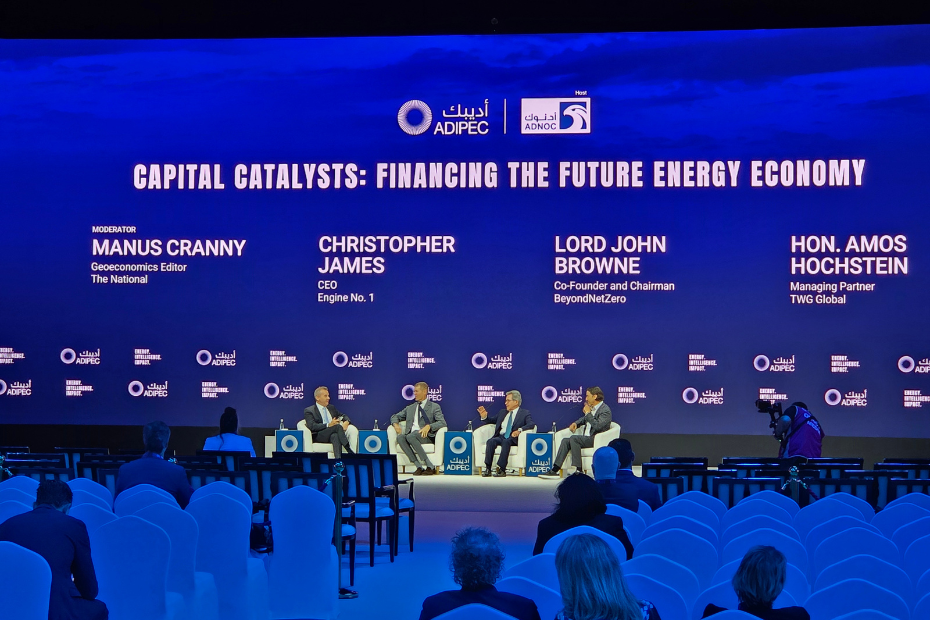

A punchy, investor-minded panel at ADIPEC 2025, moderated by Manus Cranny, geoeconomics editor, The National, brought together Christopher James, CEO, Engine No. 1, Lord John Browne, co-founder and chairman, BeyondNetZero, and Amos Hochstein, managing partner, TWG Global. Their common ground: AI is pulling the energy system into a new growth cycle, but timelines, talent, permitting and supply chains will determine who actually captures that growth.
Demand is exponential; delivery is linear
Christopher James framed the core tension succinctly: “I do think that the demand situation tied to this infrastructure build up is turning a business that hasn’t been a growth business in decades into a growth business.” The problem is the mismatch in speed. “Demand is growing exponentially because of the impacts of AI in a business that is extremely linear,” he said, warning that countries without energy security and competitive power “will de-industrialise fairly quickly.”
On execution, James was blunt: “If you look at a co located data center and new power facility that is multiple gigawatts… there’s zero chance that we’re going to be able to train that many electricians… we’re going to have to change. We’re going to be a lot more modular, a lot more repeatable.” He also flagged non-obvious chokepoints—insurance and project finance among them—arguing that pressure “is going to be a struggle for this whole decade.”
Lord John Browne’s stance was positive but pragmatic. He called out three overhangs—war, geopolitical fracturing, and climate change—“which in my book, is definitely not a hoax.” His delivery playbook was classic megaproject discipline: “Get really good people… Otherwise, a trillion dollars becomes $2tr for the same impact.” And be wary of heroic schedules: “Things do take longer… forecast the action, but don’t forecast the timescale too easily.”
Browne expects the demand-supply gap to narrow from both sides: models and chips will get more efficient, while supply options diversify. But he stressed the policy throttle: “The capabilities are there. The regulation is as bad as the old thinking. It needs to change, and it will.”
Hochstein argued that AI has dragged hyperscalers into heavy industry. “They are dependent on heavy industry infrastructure, where you need land and you need water and you need buildings and construction, and you need turbines.” Money isn’t the issue; time is. “The bottleneck is time… you have to have the entire supply chain there, which is not [there], and then you have to build it. And you have to have the permits… not just federal… you still have to have the state and local permits.”
He also reframed the builder set: “I don’t think energy companies are going to take a lot more risk at all… you’re gonna have a lot of different players coming in… more financial players… who are willing to take that risk.” In short: expect bespoke, campus-style generation for data centers, financed against long-dated AI offtake—rather than trying to push everything through legacy grid bottlenecks.
James agreed: these “highly concentrated, highly variable” loads shouldn’t be solved only with old grid-first approaches. “We probably shouldn’t try to solve them using the old infrastructure. We probably should have a bespoke, integrated infrastructure that doesn’t have all the inefficiencies that we have in the current model.”
Hochstein’s view of the AI-power build-out was unsentimental: “This is not a global question… This is about the United States and China.” Frontier-model training (the most power-hungry piece) will concentrate in those two markets; others will mostly consume. James echoed that training will be “mostly done in the US,” with European demand skewing to inference use cases.
Sanctions versus prices: the Russia reality check
Asked whether new Russia sanctions change market math, Hochstein replied: “I am highly skeptical of any sanctions being effective at all, unless the entire world gets together… The best… is to allow everybody to reduce more oil, put it on the market. Prices will come down.”
James’s bottom line for allocators: “The energy industry is becoming a growth industry… You have a real opportunity to reverse a decades long trend and grow that back into a very strong position.” But discipline is non-negotiable: “There’s a lot of characteristics of projects that tend to destroy value… we have to be very diligent on allocating capital.”
Browne’s near-term emphasis is efficiency: AI can unlock “vast amounts of efficiency,” often with short paybacks. Hochstein, whose firm launched an AI venture and JV’d with Palantir, sees energy and AI now inseparable—technology making energy “more efficient, cheaper, more resilient,” even as energy underwrites AI’s scale.
In closing, the ADIPEC discussion underscored that AI is both the catalyst and the constraint in the next phase of the global energy story. Rapid digital expansion has reignited demand for reliable, affordable power—pushing energy back into a growth trajectory after years of stagnation. Yet the road to scalability will be defined not by capital, but by execution: securing talent, streamlining permitting, and reimagining infrastructure design for speed and resilience.
