


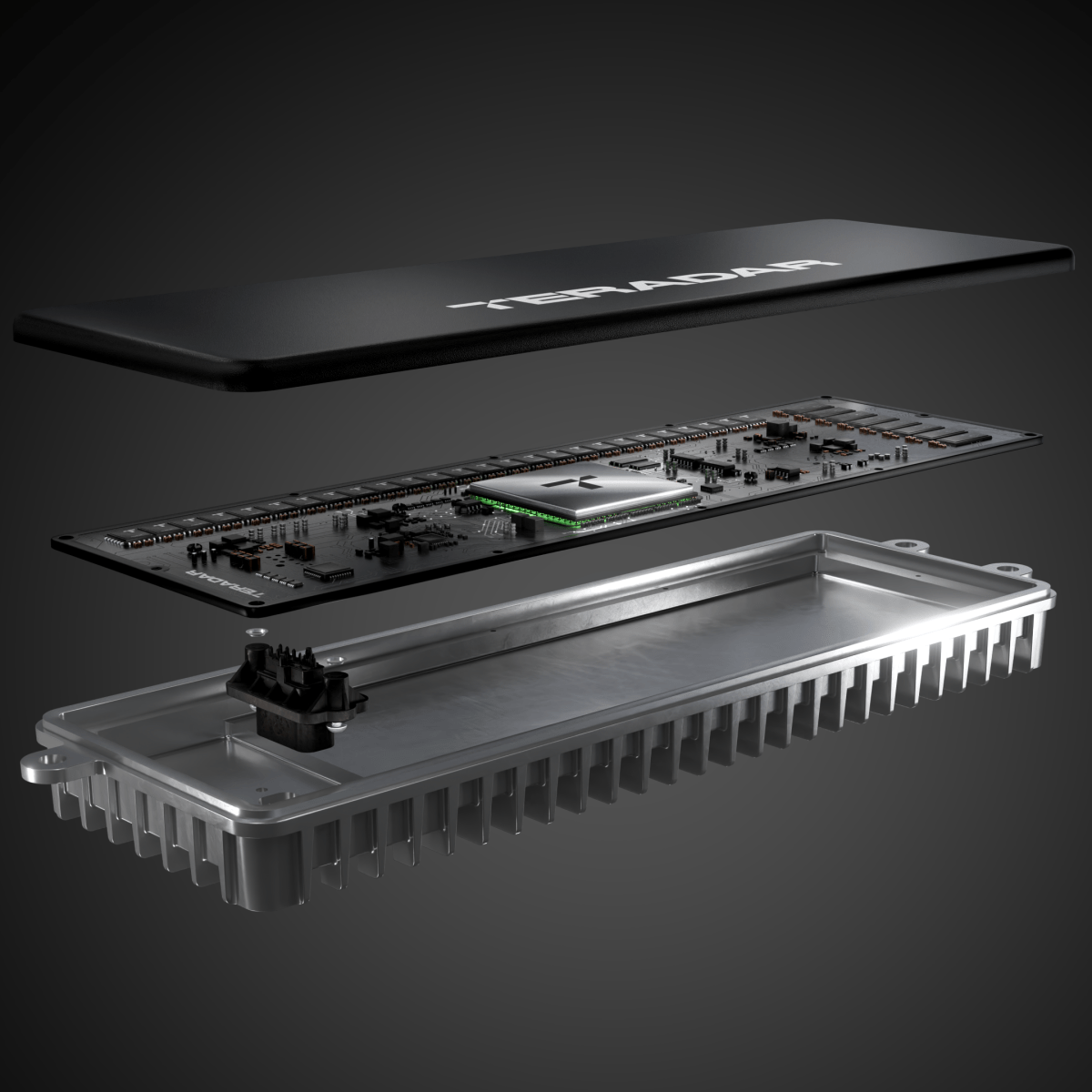
Matt Carey, the co-founder and CEO of Boston-based startup Teradar, loves when people tell him: “I don’t believe you.”
That’s “right where we want folks,” he recently told TechCrunch.
Carey has spent the last few years quietly building a solid-state sensor that sees the world using the terahertz band of the electromagnetic spectrum, which sits between microwaves and infrared. It essentially combines the best traits of radar sensors — like no moving parts and the ability to pierce rain or fog — with the higher definition afforded by laser-based lidar sensors.
It’s a product that’s never been done at this scale before, so people are understandably skeptical when Carey explains his work. A long-range, high-resolution sensor that’s also affordable? It just sounds too good to be true.
It’s usually at this point that Carey gives them a demo, like at this past year’s Consumer Electronics Show in Las Vegas. There was Carey, outside the Westgate hotel, aiming an early version of the Teradar sensor at crowds of people as reps from some of the biggest automakers watched it parse the scene in real time.
“They almost didn’t believe it until they got to play with it,” he said. “I’ve never raised money without, like, spending a lot of time in a demo of people trying to break it. And that’s how it should be, right?”
Carey’s demos — and the tech itself — helped him lock down a $150 million Series B funding round from investors like Capricorn Investment Group, Lockheed Martin’s venture arm, mobility-focused firm Ibex Investors, and VXI Capital, a new defense-focused fund led by the former CTO of the U.S. military’s Defense Innovation Unit.
Techcrunch event
San Francisco
|
October 13-15, 2026
Teradar claims to already be working with five top automakers from the U.S. and Europe to validate the tech, and expects to win a contract to put the company’s sensors in a 2028-model vehicle — meaning it will need to be ready to go in 2027. Teradar is also working with three Tier 1 suppliers, which he said the company will lean on for manufacturing.
The near-term goal for Teradar is for automakers to use its sensors to power advanced driver assistance and even self-driving systems. The “modular terahertz engine,” as the sensor is officially known, can be customized to fit any of those applications, and Carey said the price will fall somewhere between a radar and a lidar. (Think a few hundred dollars, not a few thousand.)
“How do we get the sensor on every single vehicle? I drive a Ford Focus, and there’s zero chance you’re putting a $1,000 lidar” on that, Carey said.
Carey said he was inspired to start Teradar after a friend of his died in a car crash.
“It was one of those weird corner cases where, between the sun, and the fog, it couldn’t have been solved by any existing sensor,” he said. In a situation like that, where there’s lots of glare, cameras typically struggle. Lidar would also be challenged because of the fog. And radar can only help so much with its typically lower resolution.
Carey had already been in talks to go work for an automaker, and was thinking about autonomous vehicle tech. In 2021, he started talking to his co-worker Gregory Charvat, the CTO of spatial sensor and intelligence company Humatics, about this apparent problem.
“[Charvat] was like, ‘you know, I’ve always wanted to be able to image at terahertz,’” Carey said. Shortly after, they started Teradar, with MIT’s The Engine nonprofit incubator leading its seed round.
There could be other applications for Teradar’s sensor, like in the defense sector. There’s clearly interest there based on who is on the company’s cap table. For now, Carey said the company is almost entirely focused on the automotive business.
Carey admits he’s not the first to try to leverage the terahertz part of the spectrum; there’s been a litany of academic research, and some attempts to commercialize the tech before. But a lot of that has been focused around industrial or security applications.
He said recent advancements in the silicon industry combined with a focused team of experts — including his third co-founder Nick Saiz, who Carey boasted is “the world’s best terahertz chip designer, bar none” — has allowed them to move quickly and woo big automakers.
That doesn’t mean it’s been easy, though.
“It’s very difficult to get their attention, it’s very difficult to get their dollars, and it’s very difficult to get their test track time,” he said. “The fact that they’ve unlocked all of those things for us means a big deal.”
In other words: Now they believe him.
