


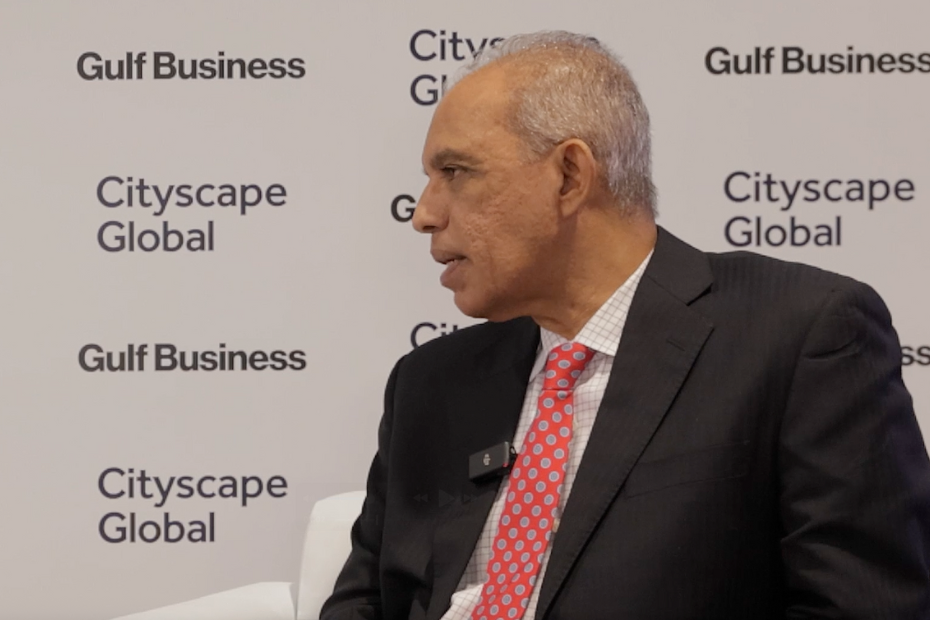

Anis Al Habshi, vice president of Arabian Dyar, speaking to Gulf Business
As Saudi Arabia accelerates the transformation of its holy cities under Vision 2030, developers are redefining what urban living, mobility, and community experiences will feel like for millions of Muslims visiting Makkah each year. Among the early movers shaping that future is Arabian Dyar, the developer behind Dayar Al-Haram — a multi-phase residential and mixed-use destination within Masar, the 3.5-kilometre urban spine being built by Umm Al-Qura.
Speaking at Cityscape Global 2025, Anis Al Habshi, vice president of Arabian Dyar, reflected on the company’s long-term commitment to the holy city and its role in raising the standard of livability and hospitality for Muslim communities worldwide. “We started our Dayar al-Haram project about four or five years ago, and we have already committed to buy several pieces of land from the master developer, Umman Pura. We have already started construction of the first phase to be completed next year,” he said.
Foreign ownership regulations — long a topic of anticipation — are also shaping buyer interest. “When we first started a couple of years ago… there’s been talk about foreign ownership being buying. But now things are getting more straight on. There’s been talk that more details of foreign ownership will be released in January,” Al Habshi noted. “To all intents and purposes, in Makkah and Medina, I think it will be strictly reserved for Muslims… for obvious reasons.”
Whether purchased for family use or investment, the demand is clear. “Many of them want to buy for second residences… a good number of interest for people who want to buy for investment purposes,” he added.
Shaping the future of Makkah through Masar
A central element of Arabian Dyar’s strategy is its integration within Masar, the major urban redevelopment programme designed to modernise and elevate the experience of visiting Makkah. Al Habshi believes Masar represents a turning point for structured, well-planned urban development around the holy sites.
“I’m just guessing, but I think maybe there was no master planning for the holy cities except for the mosque proper,” he said. “So there comes a developer, a master developer by the name of Umm al Qura, which developed Masar… this linear project, 3.5 kilometres long.”
Arabian Dyar has been involved from the earliest stages. “We have the ability to do so very early on, which was 4 1/2 years ago, and we are the first movers. So to that extent, we have first move advantage,” he said. The company’s role is to deliver high-quality residential and hospitality offerings — from upper mid-market to luxury — “so that the whole Muslim world can enjoy living in quality… while they do their pilgrimage.”
Masar’s objective is not simply development but elevating the entire ecosystem around the Haram, from mobility corridors to branded residences and hospitality clusters. Arabian Dyar sees itself as a long-term partner in making that ambition real. “We want to help Umm al Qura to make this Masar a reality,” he said.
Innovation, sustainability and partnerships
Al Habshi described the company’s approach to innovation with refreshing realism. “It’s always easy to talk about innovation, but sometimes we don’t walk the talk,” he said. Still, sustainability is a clear priority — “in terms of the materials that we use, and also in terms of the architecture design.”
Architecture in Makkah is deeply rooted in cultural vernacular. “We have the Makkah style of architecture, which started with the Hijaz,” he explained. “In Riyadh… we talk about the Salmanic or the Najdi architecture. So we do our part, and not only that, we are happy… when we submit our plans to the Royal Makkah authorities, they’ve got third-party guidelines. So that makes our job a lot easier.”
Partnerships form another foundation of the company’s strategy. “We are partnered with Masar, whom we buy land from, the Uman Kura. Then we will partner with very good consulting firms,” he said. Co-investment opportunities are emerging too, with investors expressing interest “in the last one year… in terms of co-development.”
While not explicitly discussed in the transcript, Arabian Dyar has been exploring technology partnerships — including early work on AI-driven real estate intelligence with global technology firms — reinforcing its intent to future-proof its projects.
Watch video here:
Supporting Vision 2030 through large-scale delivery
Arabian Dyar has been playing an active role in advancing Saudi Arabia’s national housing goals and supporting Vision 2030’s commitment to improve quality of life across the Kingdom.
“In the last about six years, the company has built and developed and handed over about 6,000 units… both apartments and villas. So we’ve, on the average, delivered about 1,000 units per year,” Al Habshi said. Much of this has been delivered through collaboration with the National Housing Company (NHC).
“In doing that, what we’ve done is that we are trying to help our government… to achieve the target of having 70 per cent of the Saudi population have their own homes by 2030,” he said. “So we make money along the way, but at the same time, we contribute positively and meaningfully.”
For the company, delivering premium living environments in Makkah — the spiritual heart of the Muslim world — carries responsibility beyond commercial success. It is about raising standards, improving community experience, and enabling pilgrims and residents to enjoy a higher quality of life in one of the world’s most sacred cities.
