


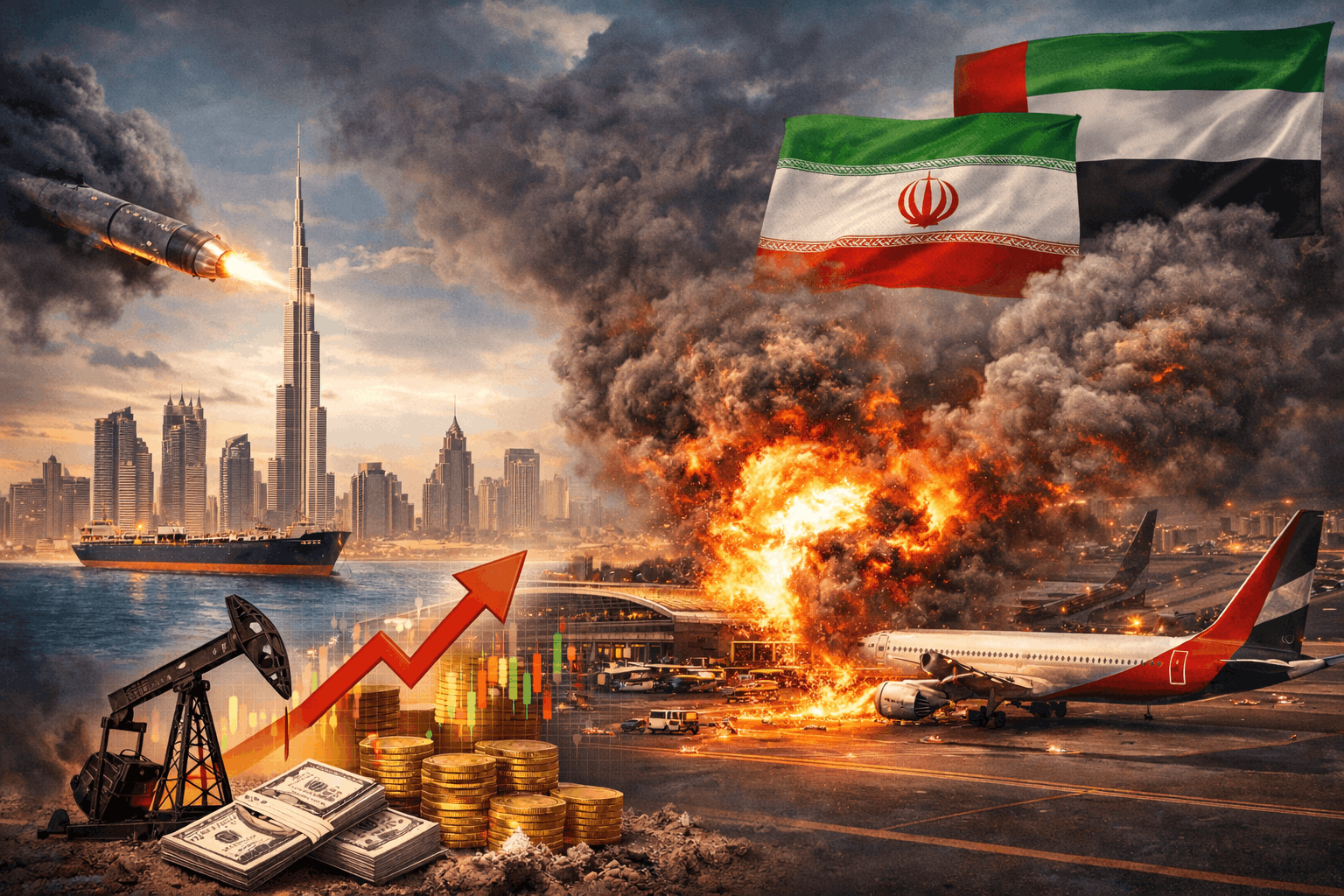
The UAE economy impact from Iran attacks has quickly become one of the most discussed economic developments in the Middle East. As geopolitical tensions rise, financial markets, trade routes, and business confidence across the Gulf region are experiencing uncertainty. The situation highlights how closely the Iran war and economy Arab markets are connected in today’s global system.
Understanding the UAE economy impact from Iran attacks requires analyzing stock markets, oil prices, aviation, tourism, supply chains, and investor sentiment. The economic ripple effects are not limited to the UAE alone; they extend across the broader Gulf Cooperation Council (GCC) and international markets.
Immediate Market Reaction
One of the first indicators of the UAE economy impact from Iran attacks was heightened volatility in financial markets. Investors reacted cautiously, leading to fluctuations in equities, energy stocks, and banking shares. Market uncertainty often triggers temporary sell-offs as traders attempt to manage geopolitical risk.
The Iran war and economy Arab narrative has historically influenced Gulf stock exchanges. When tensions escalate, investors reassess risk exposure in sectors like tourism, aviation, and logistics. Even short-term instability can affect billions of dollars in market capitalization.
Oil Prices and Energy Volatility
Energy markets are at the center of the UAE economy impact from Iran attacks. The Middle East plays a crucial role in global oil supply, and any disruption immediately affects crude prices. When geopolitical conflict threatens shipping lanes or energy infrastructure, oil prices tend to rise due to supply concerns.
Higher oil prices can create mixed outcomes for the UAE:
- Increased government revenue from energy exports
- Higher transportation and logistics costs
- Inflationary pressure on consumer goods
- Global economic slowdown risks
Within the broader Iran war and economy Arab environment, oil price volatility is one of the most powerful economic channels transmitting risk worldwide.
Aviation and Tourism Challenges
The UAE is a global aviation hub, connecting Asia, Europe, and Africa. Any security concerns affecting airspace or airport operations have direct economic consequences. The UAE economy impact from Iran attacks includes flight disruptions, booking cancellations, and reduced tourism confidence.
Tourism is a major non-oil revenue source for the UAE. Luxury hotels, shopping malls, restaurants, and event organizers rely heavily on international visitors. Even short-term disruptions can reduce occupancy rates and business turnover.
Because the Iran war and economy Arab tensions influence regional stability perceptions, global travelers may delay travel plans, impacting hospitality and retail sectors.
Trade and Supply Chain Disruptions
The UAE serves as a key logistics and re-export hub for the Middle East. Ports in Dubai and Abu Dhabi facilitate billions of dollars in trade annually. The UAE economy impact from Iran attacks also affects shipping routes and supply chains, especially if tensions increase around strategic waterways.
Rising insurance premiums for cargo shipments, delays in container movement, and cautious international trade partners can slow economic activity. Businesses dependent on imported raw materials may face cost increases, eventually passing those costs to consumers.
Within the wider Iran war and economy Arab framework, trade uncertainty creates regional supply risks that extend beyond the Gulf to Asia and Europe.
Inflation and Consumer Confidence
Geopolitical instability often fuels inflation concerns. If oil prices rise and logistics costs increase, everyday goods become more expensive. The UAE economy impact from Iran attacks may therefore be visible in fuel prices, food imports, airline tickets, and consumer products.
Consumer confidence plays a critical role in economic growth. When uncertainty rises, households tend to reduce discretionary spending. Retail sales, entertainment industries, and luxury markets may experience slower growth if tensions persist.
The Iran war and economy Arab dynamic amplifies these concerns, as investors and consumers monitor developments closely before making major financial decisions.
Investment Climate and Business Outlook
The UAE has positioned itself as a global investment hub with business-friendly regulations and strong infrastructure. However, geopolitical risk can temporarily affect foreign direct investment (FDI). The UAE economy impact from Iran attacks includes cautious investor behavior and delayed expansion plans.
International corporations often evaluate political stability before committing capital. While the UAE maintains strong economic fundamentals, regional tensions linked to the Iran war and economy Arab landscape may increase short-term risk premiums.
Over the long term, resilience will depend on diversification, fiscal management, and the speed at which regional stability is restored.
Long-Term Economic Resilience
Despite short-term challenges, the UAE has built a diversified economy beyond oil. Sectors such as finance, technology, renewable energy, tourism, and logistics contribute significantly to GDP. The UAE economy impact from Iran attacks may create temporary volatility, but structural strengths remain intact.
Governments in the region have previously demonstrated the ability to stabilize markets during crises. Fiscal reserves, sovereign wealth funds, and economic reforms provide buffers against prolonged shocks.
Within the broader Iran war and economy Arab context, regional cooperation and diplomatic solutions will play a major role in restoring confidence.
Frequently Asked Questions (FAQ)
1. What is the UAE economy impact from Iran attacks?
The impact includes market volatility, oil price fluctuations, tourism disruption, trade uncertainty, and inflation risks.
2. How does the Iran war and economy Arab situation affect oil prices?
Geopolitical tensions increase supply concerns, often leading to higher crude oil prices and global inflation pressure.
3. Will tourism in the UAE decline due to conflict?
Short-term declines are possible due to travel uncertainty, but recovery depends on regional stability.
4. Is the UAE economy strong enough to handle geopolitical tensions?
Yes, diversification, fiscal reserves, and infrastructure investments provide resilience against temporary shocks.
