


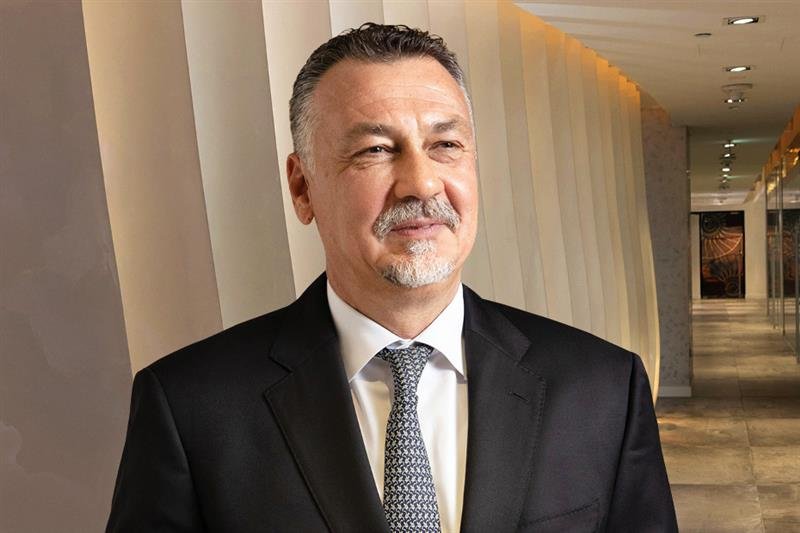

Aziz Koleilat, the president and CEO of GE Aerospace for the Middle East, Pakistan, Türkiye and CIS
GE Aerospace’s aviation journey began in 1917, when General Electric first started developing aircraft turbochargers during World War I.
In 1941, it built the first US jet engine, the I-A, which powered the Bell XP-59A, America’s first jet aircraft.
From the 1950s through the 1990s, GE became a global leader in commercial and military jet engines, powering aircraft such as the Boeing 747 and F-16 fighter jets. In the 2000s, it expanded into digital aviation and services, becoming the world’s leading provider of commercial jet engines, powering aircraft such as the Boeing 777 and 787 Dreamliner.
Today, the company’s scale is vast.
“In 2024, 3.4 billion people flew with our engines under wing. Three out of four commercial flights globally are powered by GE Aerospace and our partners: that’s the scale of our immersion with the industry,” Aziz Koleilat, President and CEO of GE Aerospace for the Middle East, Pakistan, Türkiye and CIS, told Gulf Business.

Sharpened focus after the spin-off
The company’s separation from General Electric in 2024 marked a turning point.
Many in the industry were watching closely to see how the new, standalone GE Aerospace would perform: and the shift has been particularly significant in the Middle East, a region experiencing some of the fastest aviation growth in the world.
According to IATA’s June 2025 Global Outlook, total Revenue Passenger Kilometres (RPKs) — the standard measure of airline passenger traffic — in the Middle East is expected to grow by 6.4 per cent year-on-year, outpacing the global average of 5.4 per cent and placing the region among the world’s top two fastest-growing aviation markets, just behind Asia-Pacific.
For Koleilat, the separation has brought clarity and focus amid this backdrop.
“By launching as an independent entity, we became very focused on our own mission,” he told Gulf Business.
“Our purpose is simple: we invent the future of flight, lift people up, and bring them home safely. Now all our efforts and power as an organisation are focused on that mission.”
That clarity is driving a more targeted regional strategy. Over the past 18 months, GE Aerospace has expanded its footprint, strengthened customer engagement, and begun building the infrastructure to support future growth.
“The past year has really been about growing our presence and focusing on the customer,” Koleilat explained.
From $10m investments to dust-ready design
A core part of that strategy is GE Aerospace’s $10m investment in expanding its MRO (maintenance, repair and overhaul) facilities in Dubai and Doha.
But the company’s commitment to the region began long before this, with the launch of the Middle East Technology Centre (MTC) in 2014. This facility was created to study the Gulf’s extreme operating conditions.
“The Middle East has the largest wide-body fleet in the world and a unique hub-and-spoke model around cities like Dubai, Doha and Istanbul,” said Koleilat.
“We created MTC to study the hot and harsh environment — the sand, dust, and temperature — and build the capabilities to support airlines here.”
That early work has paid off.
GE Aerospace now operates on-wing support facilities in Qatar and the UAE and continues to scale its capacity and training to support next-generation fleets, including the GE9X. Airlines in Middle East hold the company’s largest orders for this new engine.

“We’re aligning our resources and capabilities to support fleet expansion ahead of time,” Koleilat said.
“It’s about new capacity, new training, and delivering support when and where customers need it.”
Designing engines that will operate efficiently in the Middle East is unlike anywhere else. GE Aerospace has spent years analysing the chemical composition of dust from across the region, revealing significant differences between, for example, Dubai, Doha and Riyadh. This research directly influences engine design and maintenance strategies.
“We’ve built models to understand how these conditions affect engine performance,” said Koleilat.
“That led to innovations like our proprietary engine foam wash: essentially bespoke cleaning solutions that remove dust more effectively and extend engine time on wing.”
Those insights shape new products too.
“When we designed the GE9X, all of that information influenced the materials and the design,” he explained. “We combine global technology with local knowledge to create the most effective solutions.”
“Adapting to the local market means adapting to customer needs,” he added.
“If you built a car without air conditioning here, you’d have a problem. It’s the same with engines: you have to design something that can operate in this environment.”

Digital twins and AI transform maintenance
Cutting-edge engineering is only part of the story. Advanced data tools sit at the heart of GE Aerospace’s support model.
Its Analytics-Based Maintenance (ABM) platform uses digital twins — virtual replicas of individual engines — to predict maintenance needs and extend their operational life.
“Each engine has a digital model,” Koleilat explained. “We forecast performance, project how long it will fly, and work with airlines to predict when maintenance is truly needed. It’s like a car: you might be told to service it after 10,000 kilometres, but depending on how you drive, that could be 5,000 or 15,000.”
Emirates was the first airline to use ABM, and today every airline operating the GE90 on Boeing 777s in the region relies on the technology.
AI takes this predictive approach even further. “We’ve used AI to simulate field performance, predict part needs, and more accurately forecast work scopes,” he said. “It also guides technicians to the right areas based on the engine’s history.”
But Koleilat stressed that technology is always combined with physical testing to ensure safety and compliance.
“AI is like steroids,” he says. “It gives us speed and more options, but everything still needs to be validated.”
Meeting the fleet boom — while balancing sustainability
With Middle Eastern airlines entering a period of rapid fleet expansion, GE Aerospace is scaling its workforce and capabilities to match.
The company plans to increase its headcount in its regional on-wing support centres by 30 per cent.
“We also start planning with customers up to two years before a new fleet enters service,” Koleilat said.
“With Riyadh Air, for example, we’ve been preparing for their entry into service well ahead of time.”
Partnerships with airlines and maintenance organisations are central to this approach. GE Aerospace works closely with Emirates Engineering Maintenance Centre and Saudia Technic to expand their maintenance capabilities and develop local expertise.
The company has also trained 4,000 students from 50 airlines over the past decade through training programmes, apprenticeships and internships.
“We see this as a partnership — we’re in it together,” Koleilat said. “If you reduce engine removal time by 50 per cent, that means aircraft spend less time on the ground. These are the kinds of efficiency gains we deliver with our customers.”
Scale and efficiency are crucial to GE Aerospace’s future, but so is sustainability.
In 2021, IATA adopted a global commitment to reach net-zero CO₂ emissions by 2050.
Achieving that is one of the industry’s defining challenges. GE Aerospace is tackling it with a three-phase strategy: now, near and next.
- Now: GE Aerospace’s newest commercial engines are 10–15 per cent more fuel-efficient than their predecessors. Digital solutions such as Fuel Insight also help airlines measure and optimise fuel consumption, improving efficiency across fleets. With 3.4 billion passengers flying on GE Aerospace and partner-powered engines in 2024 — about three out of every four flights worldwide — even a 1 per cent fuel saving has a massive impact.
- Near: GE Aerospace is actively involved in assessing and qualifying Sustainable Aviation Fuel (SAF). All of the company’s engines can operate on approved SAF blends today and the team also supports industry initiatives for the approval and adoption of 100 per cent unblended SAF.
- Next: GE Aerospace is advancing a suite of technologies for the future of flight. This includes the CFM International RISE demonstration production that is developing Open Fan, compact core, hybrid electric and other technologies for at least 20 per cent better fuel burn than current commercial engines. These technologies are also being designed to meet customer expectations for durability. “We’ve completed more than 350 tests so far,” Koleilat says. “These technologies could be available by the second half of the 2030s.”
The next decade
GE Aerospace’s future in the Middle East is inextricably tied to the region’s ambitions. With massive investments in infrastructure, workforce development, and next-generation technology, the company is ready to help shape the next chapter of aviation in the GCC.
“Aviation has a higher economic impact here than almost anywhere else,” Koleilat says. “It’s the backbone of connectivity, tourism, business, and mega-projects. This region is becoming a real centre of gravity for the global aviation industry: people are coming here, business is growing, and aviation sits at the heart of that momentum.”
In a recent interview with Gulf Business, the PIF’s head of aviation, Muhammad Ovais Yousuf, said the aviation sector is critical to Saudi Arabia’s economic growth as it is highly accretive and delivers a GDP multiplier effect of up to fourfold.
From Vision 2030 in Saudi Arabia to global events like F1, Expos, and World Cups, aviation underpins every pillar of growth. Airlines plan to grow their fleets by more than 5 per cent annually, while governments aim to develop their own MRO capabilities and in-house technical expertise.
“Our role is to be the partner that helps them achieve that,” Koleilat says. “We want to grow with them: closer partnerships, more capability, and deeper collaboration.”
“The potential here is mind-blowing,” he adds. “The partnerships we’re building, the technology we’re bringing, the talent we’re developing: it’s all coming together. And this is just the beginning.”
