



Image credit: WAM/Website
Dubai Crown Prince and Chairman of The Executive Council Sheikh Hamdan bin Mohammed bin Rashid Al Maktoum has approved the new Architectural Identity for Dubai’s road projects, a framework designed to unify the visual language of the emirate’s expanding transport network and support its long-term urban vision. The initiative forms part of Dubai’s broader strategy to develop an integrated, sustainable, and aesthetically distinct city that enhances the experience of residents, commuters, and visitors alike.
The Crown Prince also reviewed progress on two of the emirate’s most significant transport upgrades, the Trade Centre Roundabout Improvement Project and the Al Mustaqbal Street Improvement Project, as well as the Dubai Tunnels initiative, an urban beautification programme that will transform key road tunnels into public art landmarks. Together, these programmes underscore Dubai’s commitment to expanding infrastructure capacity, improving mobility between major business districts, and integrating innovation and design into every layer of the city’s transport ecosystem, an RTA report conveyed.
Transport expansion to support urban growth
During his visit to the Trade Centre Roundabout project site, the Crown Prince was received by Mattar Al Tayer, Director General and Chairman of the Board of Executive Directors of Dubai’s Roads and Transport Authority (RTA). Al Tayer provided an overview of Dubai’s current road and transport landscape, which now spans more than 25,000 lane-kilometres and supports the movement of over 3.5 million vehicles a day.
Read more-Sheikh Zayed road gets direct link to Mall of the Emirates: What motorists need to know
Dubai’s transport network has earned international recognition for the pace and cost-efficiency of its development. According to RTA, the emirate constructs an average of 829 lane-kilometres of new roads annually, more than twice the global average of around 400 lane-kilometres. Cost efficiency per kilometre in building both highways and metro lines is estimated to be between 1.5 and 2.5 times better than in major global cities such as Moscow, Shenzhen, and Milan.
The scale and speed of these projects have delivered tangible economic benefits as well. RTA data shows that road and transport projects have contributed to increases in property values ranging between 6 per cent and 16 per cent across several districts. Between 2025 and 2027, RTA plans to deliver 72 new projects at an estimated cost of Dhs35bn, many of which will support developing commercial zones and emerging urban corridors.
Trade Centre roundabout: A critical interchange nears completion
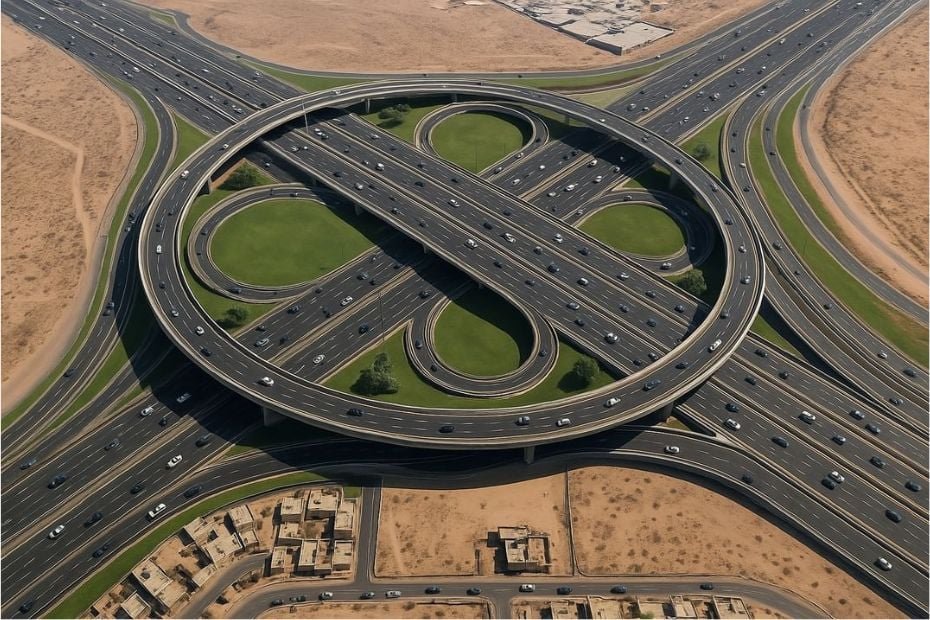
The Trade Centre Roundabout Improvement Project, one of Dubai’s most essential interchanges, is currently 40 per cent complete. The development links Sheikh Zayed Road with five major arterial streets, Sheikh Khalifa bin Zayed Street, Sheikh Rashid Street, 2nd December Street, Zabeel Palace Street, and Al Majlis Street, and forms a critical connection between several of Dubai’s busiest commercial and cultural districts. Among the areas served are Dubai World Trade Centre, Dubai International Financial Centre (DIFC), Emirates Towers, Museum of the Future, and Downtown Dubai.
The full upgrade involves the construction of seven bridges and three tunnels extending a combined 6,500 metres, with a total project cost of Dhs1.3bn.
When fully operational, the upgraded interchange is expected to benefit more than one million residents and visitors and reduce average travel times through the junction by 75 per cent.
The phased openings will begin in January next year, when two new bridges will be inaugurated to serve traffic moving from 2nd December Street towards Al Majlis Street and Sheikh Rashid Street. A key bridge connecting Sheikh Zayed Road to Sheikh Khalifa bin Zayed Street is scheduled to open in March, followed by two additional bridges in October 2026 to improve flows from Sheikh Rashid Street and Al Majlis Street towards 2nd December Street.
Al Tayer explained that the broader project includes the conversion of the existing roundabout into a surface-level intersection, which will significantly improve traffic flow from Sheikh Zayed Road to 2nd December Street and from Al Mustaqbal Street towards Sheikh Zayed Road in the southbound direction. Once completed, the interchange’s capacity will double, delays will fall from an average of 12 minutes to just 90 seconds, and travel time between Sheikh Zayed Road and Sheikh Khalifa bin Zayed Street will drop from six minutes to one minute.
The new configuration will also support free-flow connections from 2nd December Street toward Al Majlis Street, with smooth links to Al Mustaqbal Street, while enhancing movement from Sheikh Rashid Street toward Deira. In addition, a second-level bridge will provide a seamless connection between Sheikh Zayed Road and Sheikh Khalifa bin Zayed Street, reinforcing the link between major business hubs.
Al Mustaqbal Street upgrade to boost corridor capacity
The Crown Prince also reviewed the Al Mustaqbal Street Improvement Project, which stretches from its intersection with Zabeel Palace Street to Financial Centre Street. A key corridor running through some of Dubai’s most strategic business districts, the improved street will include bridges and tunnels totalling 1,500 metres and is slated for completion in 2027.
A major element of the upgrade involves widening Al Mustaqbal Street from three to four lanes in each direction. This expansion will increase the corridor’s capacity by 33 per cent, raising its hourly capacity from 6,600 vehicles to 8,800 vehicles. The improved road network will cut travel time along the corridor from 13 minutes to just six minutes.
The project includes three new tunnels with a combined length of 1,100 metres at the intersection of Al Mustaqbal Street and Trade Centre Street, and a 400-metre two-lane bridge serving vehicles travelling from Dubai World Trade Centre towards the intersection of Zabeel Palace Street and Al Mustaqbal Street. The road will also be widened over a 3,500-metre stretch between Financial Centre Street and Zabeel Palace Street.
Traffic movement will be further improved through upgraded intersections at Exhibition Street and Trade Centre Street, as well as the construction of a pedestrian bridge on Sukuk Street. Enhancements to existing junctions along the corridor will support smoother flows and improved safety for both drivers and pedestrians.
New architectural identity sets visual and functional standards
In addition to reviewing construction progress, the Crown Prince examined the newly approved architectural identity, a design framework intended to enrich the visual landscape of Dubai’s road network and standardise the aesthetic and functional elements of future infrastructure projects.
The strategy is closely aligned with the Dubai 2040 Urban Master Plan, which seeks to enhance the city’s quality of life and reinforce its global attractiveness through a cohesive architectural language. The identity draws inspiration from Dubai’s traditional architectural heritage, while integrating modern design elements that reflect the city’s rapid evolution and forward-looking ambitions.
Under the new framework, infrastructure components such as bridges, canopies, lighting, street furniture, and other visual elements will follow unified standards to ensure design consistency across the emirate. Environmental sustainability plays a central role in the design approach, with the use of eco-friendly materials and a focus on balancing technical performance with aesthetic value.
The architectural identity initiative aims to position Dubai as a model for cities seeking to blend authenticity with modernity, while also demonstrating global leadership in urban design. By elevating the visual appeal of infrastructure, the city hopes to create a more cohesive and recognisable urban character.
Six urban zones to guide design standards
A key part of the new design strategy is the division of Dubai into six principal zones based on land use, architectural form, and dominant activities. Each zone will have tailored standards for colours, materials, and architectural styles to ensure visual harmony while preserving the distinct identity of each area.
Residential zones will emphasise privacy and tranquillity, using warm colours and materials that draw from the natural environment. Rural zones will reflect organic forms and earthy tones that highlight agricultural and natural landscapes. Industrial zones will prioritise durable, practical materials and neutral colours suited to the functional nature of these areas.
Mixed-use zones will adopt a flexible architectural language that accommodates both residential and commercial needs, with design elements that support seamless integration between public and private spaces.
Historical and artistic zones will highlight Dubai’s cultural heritage through traditional details and ornamentation. High-end attraction zones, home to major landmarks and tourist destinations, will use contemporary façades, modern forms, and unique materials that reflect the city’s innovative spirit.
Global talent shapes road identity through Dubai Urban Challenge
Sheikh Hamdan also reviewed the outcomes of the Dubai Urban Challenge, a global design competition launched by RTA to shape the architectural identity of the city’s road network. The challenge drew more than 500 artists and designers from 91 countries, underscoring international interest in contributing to Dubai’s evolving urban form.
Entries were evaluated by a panel of leading local and international architects. The winning submissions included A Thread Through Time by Oliver Charles of the United Kingdom; Breathing Masonry by Mohammed Ayash of Saudi Arabia; and Echo by Giulietta Debrutti of Argentina.
These works will influence the aesthetic direction of road infrastructure across the emirate, incorporating innovative and culturally grounded design elements.
Dubai tunnels initiative to transform infrastructure into public art
At the end of his visit, the Crown Prince reviewed the Dubai Tunnels initiative, a programme designed to turn urban transport infrastructure into extensions of the city’s cultural and artistic identity. The initiative will cover the beautification of 18 tunnels across three phases.
The first phase includes tunnels on Al Khaleej Street, Umm Suqeim Street, and Oud Metha Street. The second phase covers tunnels on Museum of the Future Street, Trade Centre Street, and Al Sukook Street. The third phase will beautify tunnels along Al Wasl Street, Jumeirah Street, and Umm Suqeim Street.
The RTA outlined the technologies being used in these tunnel upgrades, including adaptive smart lighting systems that improve the user experience and enhance safety. High-performance wall panels designed to withstand heat and humidity will display artistic designs, contributing to Dubai’s modern aesthetic identity. The materials used across these tunnels are designed to be more sustainable and efficient, reflecting the city’s goal of integrating beauty and functionality in every layer of urban development.
