


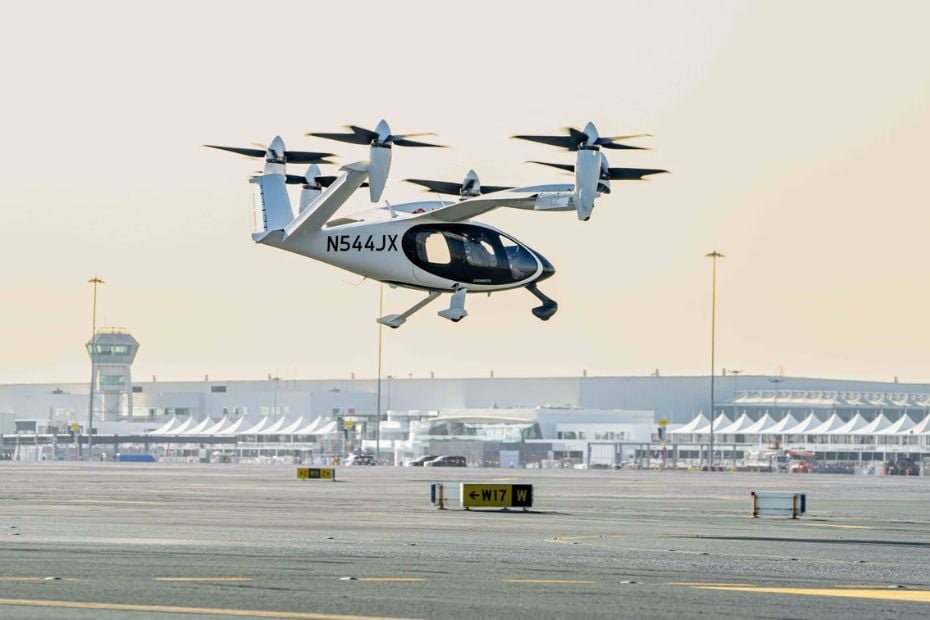

Image credit: Dubai Media Office/Website
Dubai set a new global benchmark in advanced transportation with the successful completion of the first-ever crewed electric vertical take-off and landing (eVTOL) aerial taxi flight between two distinct points in the UAE. The achievement, accomplished by the Roads and Transport Authority (RTA) in partnership with Joby Aviation, underscores the emirate’s accelerating ambition to become the world’s leading hub for innovative, sustainable, and future-ready mobility solutions.
The pioneering electric aerial taxi flight departed from the Dubai Jetman Helipad in Margham and landed 17 minutes later at Al Maktoum International Airport (Dubai World Central). Coinciding with the Dubai Airshow 2025, the operation also makes Joby the first company worldwide to fly a crewed eVTOL aircraft between two separate locations in the UAE, according to a WAM report. This milestone places Dubai squarely at the forefront of the race to commercialise advanced aerial mobility.
Read more-Abu Dhabi charts the skies: UAE builds global model for air taxi rules
Adding momentum to the achievement, RTA announced major progress on the infrastructure required to support aerial taxi operations. Skyports Infrastructure, a UK-based company specialising in advanced aerial mobility facilities, has completed 60 per cent of the construction of the first eVTOL vertiport in the Emirate, located near Dubai International Airport (DXB). This vertiport, which has now reached its highest structural point, is the first of its kind globally and will serve as a cornerstone of Dubai’s aerial mobility network.

The vertiport spans four floors and covers a total area of 3,100 square meters.
It includes multiple vehicle parking levels, take-off and landing pads, designated zones for charging and taxi parking, and fully air-conditioned passenger facilities. Designed to international safety standards, the vertiport is projected to handle approximately 42,000 aerial taxi landings annually and accommodate around 170,000 passengers per year. Skyports Infrastructure will lead design, construction, and operations, while RTA will govern overall system integration.
To expand this network, RTA has also signed agreements with Emaar Properties, Atlantis The Royal, and Wasl Asset Management Group to create additional vertiports embedded within their real estate developments. These strategic locations will form four interconnected hubs, shaping the launch network planned for 2026.
Dubai leadership charts a vision for the future of mobility
Mattar Al Tayer, director general and chairman of the board of executive directors of the RTA, described the successful first crewed eVTOL flight as a landmark moment in Dubai’s ongoing pursuit of transport innovation. He emphasised that the achievement reflects the forward-thinking vision of Sheikh Mohammed bin Rashid Al Maktoum, Vice President, Prime Minister, and Ruler of Dubai. Sheikh Mohammed’s goal is to position Dubai as the world’s best city in quality of life and the most prepared for the smart, sustainable mobility systems of the future.
Al Tayer further highlighted that the milestone is aligned with the directives of Sheikh Hamdan bin Mohammed bin Rashid Al Maktoum, Crown Prince of Dubai, Deputy Prime Minister and Minister of Defence, and Chairman of the Executive Council of Dubai. Sheikh Hamdan’s focus on innovation and advanced technological adoption is central to establishing Dubai as a global leader in mobility solutions designed to serve humanity.
According to Al Tayer, Joby Aviation’s successful flight between two distinct points validates the strength of RTA’s operational framework for aerial mobility and proves the system’s readiness to operate in shared airspace. He said this accomplishment will initiate a new phase of integration between smart mobility systems across the emirate and reinforce the trust of global partners in Dubai’s regulatory and technological environment.

Infrastructure progress expands connectivity vision
In addition to the progress on the primary vertiport, Al Tayer noted the importance of the three new agreements that will further expand Dubai’s network of vertiports. He said this coordinated expansion will enable exceptional air mobility services for residents and visitors, while enhancing connectivity between business districts, key urban areas, tourist landmarks, and high-traffic zones.
He added that Dubai’s infrastructure and regulatory readiness, developed through close collaboration with the General Civil Aviation Authority (GCAA), Dubai Civil Aviation Authority (DCAA), and Dubai Air Navigation Services (DANS), make the emirate well-positioned to adopt aerial mobility technologies at scale. These collective efforts lay the foundation for the commercial launch of aerial taxi services in 2026.
The system is expected to transform travel efficiency. For example, the typical 45-minute road journey from Dubai International Airport to Palm Jumeirah could be completed in about 10 minutes via aerial taxi. Al Tayer emphasised that the new service will integrate seamlessly with current public transport modes and individual mobility solutions such as electric scooters and bicycles, delivering a smooth multimodal experience for commuters.
“RTA is steadily progressing towards the commercial launch of the aerial taxi service in 2026,” he said. “This solidifies Dubai’s position as the city of the future and a global hub for innovative and sustainable urban mobility solutions.”
Joby Aviation advances towards passenger flights in 2026
Joby Aviation founder and CEO JoeBen Bevirt praised the collaborative environment in Dubai, stating that the company is making strong progress across all aspects of its development, from flight demonstrations to infrastructure readiness. He attributed this momentum to the close cooperation between Joby, RTA, government agencies, and infrastructure partners.
Bevirt described the Dubai initiative as key to realising the broader vision of making urban air transport a part of everyday life. He said the team is “closer than ever” to enabling residents and visitors across the UAE to experience advanced aerial mobility.
Joby’s eVTOL aircraft features six rotors, four battery packs, and is capable of a range of up to 160 kilometres. With a top speed of 320 kilometres per hour, the aircraft operates on electric power and produces no harmful emissions. Its quiet operation, significantly quieter than conventional helicopters, makes it ideal for urban environments. The aerial taxi can carry four passengers along with a pilot, delivering reliable and comfortable air travel with vertical take-off and landing capabilities that reduce space requirements at stations.
Joby Aviation continues to accelerate its flight testing and operational evaluations in Dubai. Earlier testing phases took place in Margham, where the company conducted a series of crewed eVTOL flights. These tests were performed in partnership with RTA, the DCAA, GCAA, and DANS, ensuring that evaluations reflected Dubai’s unique environmental conditions.
Heat, wind, and other local climate factors remain essential variables in certifying the aircraft for regional operations. The results of these tests confirmed the aerial taxi’s performance capabilities and strengthened the roadmap for full commercial deployment.
The company has planned a regular schedule of additional trials and public demonstrations leading up to 2026, reinforcing Dubai’s ambition to be the first city globally to make advanced aerial mobility a reality.
Building the foundation for the 2026 route network
The vertiport network under construction will form the backbone of Dubai’s 2026 aerial taxi launch. In addition to the flagship vertiport near DXB, three additional vertiports will be built in partnership with major Dubai developers.
A vertiport located at the Zabeel Dubai Mall parking area, managed by Emaar Properties, will support the world’s leading shopping and entertainment destination, which attracted nearly 111 million visitors in 2024. Designed to integrate seamlessly into Dubai Mall’s high-volume traffic flow, the vertiport will provide direct links to iconic destinations such as the Burj Khalifa.
The second vertiport will be developed at Atlantis The Royal on Palm Jumeirah. Positioned at one of Dubai’s most recognisable hospitality landmarks, this location provides immediate access to beachfront destinations, restaurants, and entertainment venues in the Palm Jumeirah district.
The third vertiport will be built at the American University in Dubai parking area in Dubai Marina, under Wasl Asset Management Group. With its close proximity to Dubai Internet City and several residential and commercial zones, this vertiport will connect a major entertainment and residential hub to key economic districts.
Together, these vertiports will establish a citywide network capable of supporting fast, quiet, zero-emission aerial taxi travel, creating a foundational route map for the 2026 launch.
