


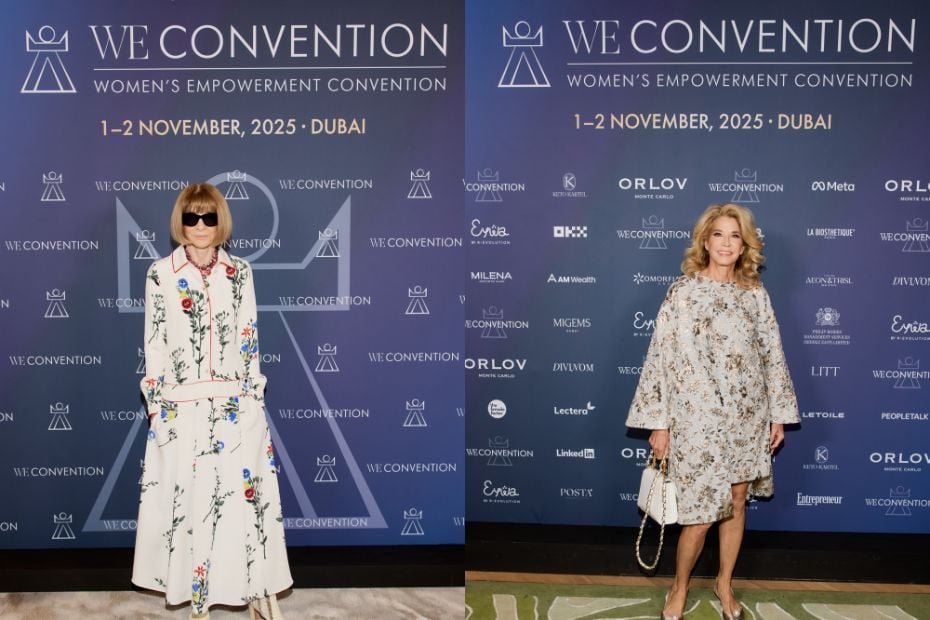

Image credit: Supplied photos
The WE Convention 2025, held on November 1–2 at Atlantis The Royal, became a rare convergence of two global voices who have shaped culture, business, fashion, publishing, and the modern narrative of women’s independence. Mila Semeshkina, the founder and president of the WE Convention and the WE Council, a leading global platform for women’s empowerment and leadership development, curated the event to highlight these transformative stories. Anna Wintour, global editorial director of Vogue and chief content officer of Condé Nast, and Candace Bushnell, the international best-selling author whose writing redefined women’s lives for a generation, offered audiences a candid look at leadership, creativity, ambition, and the evolving expectations placed on women today.
What emerged from these conversations, “Anna Wintour: Power, Mystery, and the Legacy of a Fashion Icon” and “Candace Bushnell & Carrie Bradshaw: Breaking Taboos and Redefining Women’s Lives”, was a sweeping reflection on work, purpose, culture, and the power of storytelling. It became clear that, whether in a newsroom or a writer’s room, success is forged through discipline, perspective, humor, and a deeply held belief that voices, especially women’s voices, deserve amplification, even when industry structures say otherwise.

A creative childhood and the making of a leader
Anna Wintour began her conversation by reflecting on her early surroundings in the UK, where creativity and influence shaped her worldview long before she became one of fashion’s most recognisable leaders. She recalled growing up “in a house full of creative people,” where her father worked as a well-connected editor. Writers, politicians, and artists filled the rooms of her childhood home, embedding in her the conviction that journalism was her destiny.
Read more-From Anna Wintour to Candace Bushnell: Dubai’s WE Convention redefines women’s leadership
“I think the most important thing in any career is to keep learning as you go, and always listen and stay aware of the people around you,” she said. That belief, learned early, became the leadership principle she still carries. For Wintour, adaptability, not perfection, is the foundation of influence.
She emphasised that leadership must be forward-moving rather than reactive.
“I believe it’s more important to be a solution-oriented leader than someone constantly focused on damage control,” she explained. The simplicity of honest communication, of making one’s opinions known with clarity, remains central to her decision-making. She repeated the philosophy passed down by her father: a leader should only hire people they look forward to seeing walk into their office. “If not, don’t take the job,” she said. “Leadership should be welcoming.”

Breaking into a male-dominated newsroom
Wintour did not shy away from acknowledging the barriers of her early career. Journalism in London, she noted, “was completely dominated by men.” Women were limited to “cooking, interior decorating, or other female-oriented positions.” Yet the newsroom’s rapid energy drew her in, the constant churn of editions, from morning to late-night, created the pace she wanted.
Her father’s work as an editor also meant that news never waited. She recounted a childhood moment when her family cut a holiday short because Marilyn Monroe had died, and the story had to be covered. “There was no internet back then, just phones,” she recalled. From that, she learned a simple truth: “A leader must always be actively involved. An absent leader is not a true leader.”
The pandemic stress test
Wintour described the COVID period as the most challenging moment of her career. Remote work, she said, drained the creativity that thrives when teams share space, ideas, and energy. She highlighted how, during the Paris collections, in-person conversation often sparked some of the most dynamic editorial decisions.
“That season was especially challenging, with 13 or 14 new creative directors in Paris,” she said. Navigating that shift remotely, she emphasized, underscored the irreplaceable value of human exchange.
Yet COVID also prompted innovation. Wintour spoke of mentoring young designers such as Jacqueline Lazarau, Tom Brown, and Rachel Scott, and of transforming the Cash Fund into “Common Right” to support designers in need. “Your greatest strength is most evident in difficult times,” she noted.
Creativity, business, and the power of the right team
A key theme throughout her session was balance, specifically, how leaders can create harmony between artistry and business. Wintour stressed that self-awareness is critical. “The key is recognising your own strengths and surrounding yourself with talented people,” she explained.
She warned against building teams of people who simply agree with everything a leader says. “That’s boring and unproductive,” she said. Instead, she advocated for creatives who challenge assumptions and widen perspectives.
She credited global collaboration for strengthening Vogue’s editorial voice.
With teams across France, Spain, Dubai, and beyond, she emphasised that listening to regional expertise drives success. “What works in Dubai may not work in New York.”
Women, barriers, and the path forward
Asked whether barriers still exist for women, Wintour’s response was immediate: “Of course they do, but we must keep pushing.” She praised the women leaders she met in Dubai, calling them “remarkable” for how they challenge misconceptions.
She also spoke of her personal influences. Hillary Clinton serves as a role model and friend, but her earliest mentor was Katharine Graham of The Washington Post. Graham, she said, demonstrated how values and courage can shape an organisation’s identity, even when the world isn’t prepared to see a woman lead.
Other life lessons came from unexpected places. Wintour described an interaction at the Metropolitan Museum of Art about an artist whose work sparked conversation because of a guard’s challenge. The moment reinforced her belief that “everyone has insights to offer, and you never know where inspiration may come from.”
Passion, energy, and the everyday pursuit of purpose
When asked how she sustains energy in such a demanding role, Wintour answered simply: she loves what she does. “I don’t believe in all-nighters, I believe in balance,” she said. The joy, she explained, comes from “working with inspiring people.”
Wintour also highlighted Dubai’s rising influence. She praised the clarity and discipline of women leaders in the region and the city’s global reputation as a hub of creativity and business.
Her admiration for visionary designers also took center stage. She pointed to Sarah Burton as her favorite designer and reiterated that great creators are defined by conviction. True designers, she said, are not distracted by others, “they don’t look to the right or to the left.”
She spoke at length about Giorgio Armani’s legacy, describing a Milan exhibition that captured his evolution from the 1970s onward. His clarity of vision, his understanding of celebrity culture, and his ability to merge fashion with art, architecture, literature, and history made him transformative.
Her reflections expanded into stories of Paris dinners, where conversations with creative minds touched on everything from architecture to books to personal lives. In these exchanges, she found proof that fashion never exists in isolation. “He was a master storyteller,” she said, recalling Chanel shows set in supermarkets, on beaches, or next to rockets. Style became spectacle, but always driven by belief and spirit.
Risk, technology, and reinvention
Wintour made clear that great creators thrive because they take risks. “What distinguishes truly creative people from those who are merely competent is the willingness to take risks, try new things, and learn from mistakes,” she said. In a world moving faster than ever, especially with digital transformation, leaders must stay open and curious.
“When I started, we were focused on print, producing 12 issues a year,” she explained. “Now, we think about social media, digital content, video, events, and global audiences.” Reinvention, she suggested, is non-negotiable.
Leading a global brand with local vision
With 28 editions of Vogue, each rooted in distinct cultures, Wintour underscored the importance of listening to local leadership. “They often know their markets better than you do,” she said. Leadership, therefore, means respecting regional knowledge while mentoring teams to uphold Vogue’s standards.
Global leadership, she said, is a balance of patience, communication, and understanding. It also requires constant observation, of social media, of videos, of the streets themselves, because culture shifts quickly, and relevance demands awareness.

Candace Bushnell: A different lens on power and women’s lives
If Wintour’s conversation explored leadership and creativity from the executive and editorial vantage point, Candace Bushnell’s session offered a deeply personal view of ambition, independence, and cultural influence.
Bushnell opened with a nod to the characters who became cultural icons: Samantha, Charlotte, Miranda, and Carrie. “For many years, through their stories, you didn’t just show us women’s lives; you redefined what success and independence mean,” she said.
Her interviewer asked how it all began. Contrary to common belief, The New York Observer was not her starting point. “I started writing professionally when I was 19,” she said, adding that her entire career stemmed from an epiphany at age eight. Looking up from a book in school, she simply knew she would be a writer.
Bushnell’s childhood mirrored Wintour’s in one way, the influence of a brilliant father. Her father invented the fuel cell used in the first space rockets and pushed her to “change the world.” His expectations became the lens through which she defined purpose. “Maybe I could win the Pulitzer Prize, that would show everybody,” she said of her childhood logic.

New York women and the birth of a cultural era
Bushnell recalled being captivated by the women of New York, “so interesting and so different.” Their lives inspired her early work and later shaped the characters who would eventually redefine television.
“Sex and the City,” she emphasised, was never simply about romance or fashion. “It is about money, power, status, and how those forces shape relationships.” She described herself as a “cultural anthropologist examining the human condition, the real human condition, not the fantasy.”
Her signature thread? Humor. “The thread running through all my work is that it’s funny,” she said, and that tone carried into the show that became a global phenomenon.
The evolution of independence and the new rules of life
Bushnell argued that society has changed so significantly that the idea of loneliness itself must be reevaluated. People live differently now because they can. “At one time, you really couldn’t be single; now you can,” she said. With choices comes freedom, and new social norms.
She illustrated this thought with a story of a plastic surgeon she once interviewed. When asked why so many people get plastic surgery, the surgeon replied, “Because they can.” Bushnell suggested that this logic explains much of modern behavior.
Her greatest personal lesson: you cannot rely on past achievements. “You can’t rest on your laurels,” she said. With 11 or 12 books written since Sex and the City, she remains committed to process and passion. “I just keep working.”
Women, success, and the next generation
Bushnell reflected on what success looks like now. Young women today, she said, are “so accomplished and bold.” They are not defined by the traditional pressures her generation faced. They pursue careers, independence, and friendships with confidence.
She cited Anna Wintour and Martha Stewart as examples of true success, admiring Stewart’s resilience after being jailed as a result of being “the first female billionaire.” Stewart’s instinct to teach fellow inmates, and to later wear a poncho crocheted by one of them, deeply struck Bushnell.
Her reflections underscored a shared theme with Wintour: women succeed not by conforming but by elevating others.
A closing reflection: Two voices, one story of influence
Across the WE Convention 2025, the conversations between Anna Wintour and Candace Bushnell formed a unified narrative about leadership, purpose, creativity, and the evolving identities of women in business and culture.
Both women built careers in industries where the rules were written without them in mind. Both responded not by bending to the system but by reshaping it.
Wintour’s leadership philosophy, rooted in communication, perspective, global awareness, and deliberate hiring, aligned seamlessly with Bushnell’s belief in independence, humor, and truth-telling.
Their stories remind us that business and culture are interconnected: leaders influence society, and storytellers influence leaders. In Dubai, their voices converged to deliver one message: success is a process, creativity is a discipline, and empowerment is not a trend but a legacy.
