



Image: Supplied
David Ghiyam isn’t your typical entrepreneur. As president and co-founder of MaryRuth’s Organics, he helped grow the wellness brand from a kitchen startup into a billion-dollar company, all without external funding. But behind the business success is a deeper story — one rooted in consciousness, leadership, and purpose.
A former hedge fund trader turned spiritual teacher, David brings a rare blend of strategic discipline and inner awareness to business. He believes that sustainable growth starts with alignment — between people, values, and vision. Today, as MaryRuth’s Organics expands globally, including its growing presence in the Middle East, David is exploring how consciousness-driven leadership can reshape how companies scale, inspire teams, and serve communities.
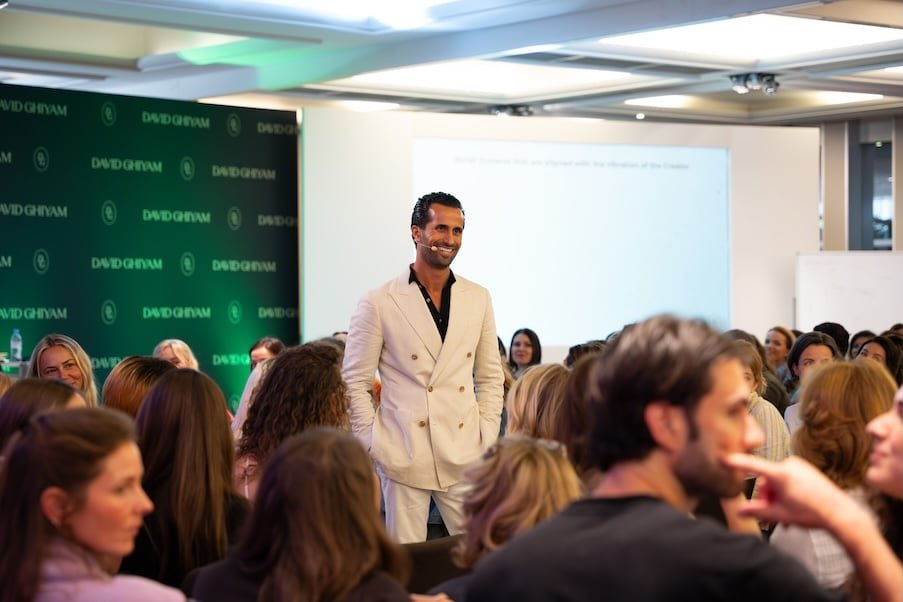
Ahead of his first seminar ‘Manifesting Your Soul’s Destiny’ in Dubai, David discusses how he applies spiritual principles to business strategy, what conscious leadership looks like in practice, and how entrepreneurs can lead from purpose without losing commercial edge.
You’ve scaled MaryRuth’s to unicorn status without outside funding. What key leadership principles guided you in building a profitable, globally distributed business?
Building our brand MaryRuth’s took using many of the tools that I have been teaching about for over 20 years. If I had to pick the most important ones it would be:
First, we operated from abundance, not scarcity. Most businesses are out there chasing funding because they’re running on fear and limitation. We built profitability into our DNA from day one. For us, it was fundamental to understand that when you’re creating real value, the universe provides what you need. We didn’t need to give away equity or control because we trusted our mission 100%.
Second, put people before profits, and the profits take care of themselves. This is the most practical wisdom I can give you. When you genuinely serve your customers, your team, your mission abundance flows naturally. We obsessed over creating products that actually transformed people’s health and wellness. That authentic value creation became our greatest marketing asset.
Third, lead with certainty even when everything’s uncertain. But, I want to clarify what certainty means in this context. It is being deeply connected to your vision and have such an unwavering commitment to it that you know everything that happens in the process of making it happen is for the best (especially when you can’t quite see it that way). That knowing has trickled down to our entire organization and attracted exactly the right people, partnerships, and opportunities we needed.
How do you integrate your spiritual and consciousness teachings into your leadership style and business decision-making?
One thing I learned early on when I started coaching incredibly successful people in Los Angeles was that spirituality and business are not that different from each other; they actually complement each other really well in helping all of us learn the life lessons we came to learn.
Every major decision at MaryRuth’s came from asking one question: “What serves the highest good?” Not just our good, but our customers’, our team’s, the planet’s highest good. When you align with how the universe actually works, with the natural laws of giving and receiving, you tap into intelligence way beyond what your limited minds can (at times) figure out. We call this our ego; that part of us that has fears and doubts about what we’re capable of or what success can or should look like in our lives.
Practically, I start every day with consciousness work: meditation, study, setting my intentions. And this isn’t me escaping business reality; it’s how I access the clarity that cuts through all the noise. Before any major decision, I get quiet and tune into my soul’s guidance, not just my mind spinning through calculations.
I brought these same tools to my team. We built a culture where people understood they were part of something bigger, a mission to elevate global wellness. And when your team connects to purpose beyond just the paycheck, you unlock the kind of effort and commitment that no amount of money can buy.
Manifesting Your Soul’s Destiny is your first seminar in the Middle East. What inspired you to bring your teachings here, and what do you hope leaders in the region will gain?
The Middle East represents something really profound for me personally and for this work.
This region is the birthplace of so much ancient wisdom. Spiritual teachings that have shaped human consciousness for thousands of years. Bringing “Manifesting Your Soul’s Destiny” here feels like a wonderful opportunity to bridge that gap between ancient and modern, and to share the teachings that I’ve seen help thousands of people discover and harness their own power, their own ability to create their life story.
Leaders in this region are positioned at a unique inflection point. There’s tremendous wealth, ambition, and vision here. But I’ve also seen how many successful people still feel empty, like something’s missing. What I hope they gain is the understanding that true leadership is about mastering your internal state; and it has very little to do with dominating external circumstances.
When you align with your soul’s destiny, when you understand how to work WITH universal laws rather than against them, you create legacies that elevate humanity.
In coaching over a million people, what are the most common leadership challenges you’ve observed, and how can individuals overcome them?
Every single person that I have ever coached has their own singular story, but after 20 years doing so I have found some through lines amongst them and what their stories have to offer all of us:
Firstly, leading from the ego instead of the soul. Most leaders are driven by this need to prove something: to themselves, their parents, their critics. And it creates this exhausting, unsustainable way of leading. The real transformation happens when you shift from asking “What will make me look successful?” to “What is mine to give?”
Another one is, confusing activity with impact. Leaders get trapped in this constant doing, constant busyness. The most powerful leadership actually comes from your state of being. Being clear, being centered, being aligned. When you lead from that place, you’ll accomplish more in two hours than most people do in two weeks. Compressing time is a lesson all great leaders and entrepreneurs should learn.
Lastly, treating spiritual work as separate from business work. Leaders compartmentalise everything: “I’ll be spiritual on Sunday and ruthless Monday through Friday.” That fragmentation creates internal conflict and seriously limits what you’re capable of. The solution is finding a way to integrate everything. Bringing consciousness into every decision, every interaction, every moment.
I recommend developing a daily practice that connects you to your soul. Even just 10-20 minutes of meditation, reflection, and intention-setting will transform your leadership. Stop seeking validation externally and start accessing the infinite wisdom within.
How do you cultivate resilience and adaptability in both business and personal life during periods of rapid growth or uncertainty?
I have always thought that resilience is not to be confused with just pushing through or being tough. True resilience comes from understanding that challenges aren’t obstacles to your path; they ARE the path. Every setback, every crisis, every moment of uncertainty is the universe offering you an opportunity to expand and access new levels of wisdom and capability.
At MaryRuth’s, we went through periods of explosive growth that honestly would have destroyed most companies. Product shortages, supply chain nightmares, scaling pains. Each one felt like an existential threat in the moment. But I trained myself and my team to ask: “What is this here to teach us? What capacity is this crisis developing in us?”
Embrace uncertainty as creative potential. Most people fear the unknown because they’re disconnected from their soul’s power. But, when you trust in your connection to infinite intelligence, uncertainty becomes exciting, not terrifying.
Self-awareness and reflection are critical for leaders. How do you develop these qualities in yourself and your teams?
Self-awareness is the differentiator between average leaders and transformational ones.
Developing self-awareness is actually quite simple. You must commit to being a perpetual student of yourself. That means regular reflection, ruthless honesty, and willingness to see your blind spots. I keep a daily journal where I examine not just what happened, but who I was when something happened. Did I react from fear or respond from wisdom?
I also work with teachers and coaches who aren’t afraid to call me on my patterns. Too many leaders surround themselves with yes-people. I actively seek out people who will lovingly but firmly point out where I’m still operating from ego, where I’m playing small, where I’m out of alignment.
For our teams at MaryRuth’s, we have always strived to create a culture where reflection is valued as much as action. We built in regular time for team members to step back and assess not just results, but the process. How did we show up? What worked? What didn’t? What do we need to learn?
MaryRuth’s operates in 180 countries while maintaining profitability. What lessons in global leadership, team building, and cultural adaptability can you share?
Reaching the point where we are now operating in 180 countries taught me something most business books completely miss: universal principles transcend cultural differences.
The desire for health, for wellness, for feeling good in your body: that’s human, not cultural. Our success came from staying anchored in that universal truth while remaining humble and curious about how it shows up differently across cultures. We do these key things to make this teaching actionable:
Hire for values, train for skills. We didn’t try to create one homogeneous global culture. We hired people who aligned with our core mission: elevating human wellness. Then, empowered them to execute that mission in ways that resonated with their local culture.
Listen more than you speak. Especially in new markets, I spent way more time listening to local leaders, understanding their perspective, learning their needs, than I did imposing our “proven” strategies. That kind of humility is simply put: business smart.
Build systems, but trust people. We created solid systems for quality, operations, and communication. But we never let systems replace human wisdom and local intuition. The system provides the framework; people bring the adaptation.
Let go of control. This was the hardest one for me. I had to learn to trust that people aligned with the mission would make good decisions, even if they weren’t the decisions I would make. That trust unlocked massive scaling because I wasn’t the bottleneck anymore.
When you’re operating from authentic purpose and universal principles, cultural differences become enriching rather than limiting. Different perspectives and approaches can all serve the same mission.
For aspiring leaders looking to align purpose, passion, and performance, what practical tools or habits have you found most effective in unlocking potential?
Here’s the framework I give every leader who wants to unlock their potential:
First, start your day with a morning power hour. This should look something like 20-minutes for meditation or spiritual reflections, 20-minutes for studying something that elevates your consciousness, 20-minutes for visioning – I like to use this time to connect with my biggest goals and why they matter. I know for some this may sound like a luxury, especially if you have business in different time zones and want to catch up with it as soon as you wake up. But, your morning time is the foundation of your whole day, investing in the foundation of it should be the most important thing you do.
Second, once a month, examine every major commitment: projects, relationships, investments of time and energy. Ask yourself: “Does this align with my soul’s purpose, or is this just an ego-driven obligation?” Then have the courage to eliminate or delegate anything that’s pure obligation.
I also think it is incredibly important as business leaders to track what gives us energy versus what drains us. Then, architect your life to maximise the former and minimize the latter. High performance is about working with your natural energy, not against it.
Most people are trying to manufacture motivation and sustain performance through sheer force of will. That’s exhausting and unsustainable. But when you align with your soul’s purpose, you tap into infinite energy, infinite creativity, infinite resilience.
This is the practical wisdom that has transformed my life and the lives of millions of people I’ve coached. I’m so excited to share more of it with the community of highly driven entrepreneurs and business people in the Middle East.
