


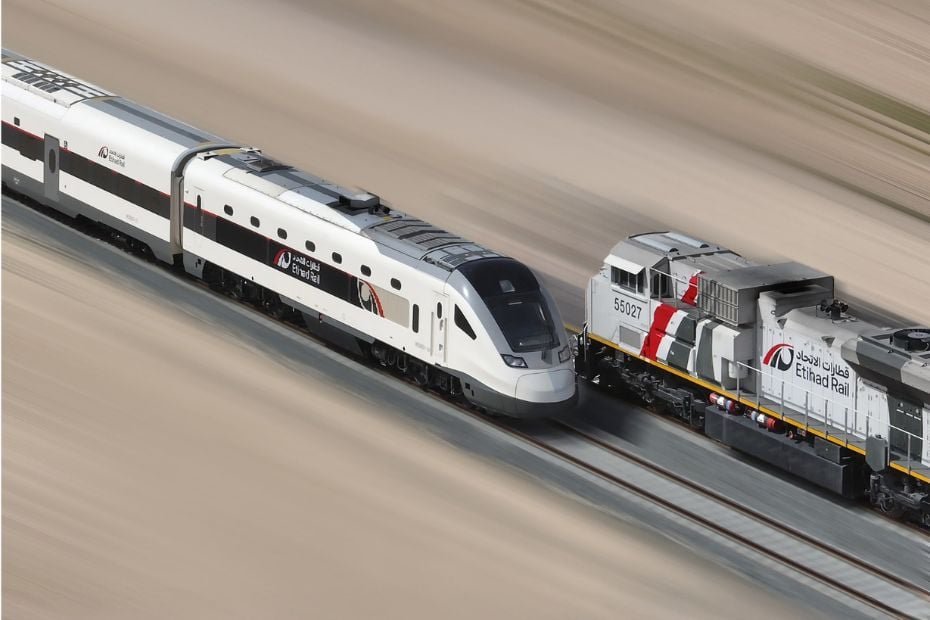
Image credit: Etihad Rail/Twitter
The planned Etihad Rail network for the UAE is expected to include a stop at Al Maktoum International Airport (DWC), a move set to transform the nation’s travel landscape. Paul Griffiths, CEO Dubai Airports, envisions an integrated system where passengers en route to the airport can check in their baggage at train stations, effectively merging air and rail travel into a single, seamless journey.
This vision, once realised, will position the UAE among the few nations globally offering a truly unified transport ecosystem, enabling travelers to move effortlessly from city centers to airport terminals without handling their luggage twice. For a country known for its innovation and infrastructure prowess, the Etihad Rail–DWC connection represents a critical step toward redefining mobility and enhancing the passenger experience across the Emirates.
Read more-Etihad Rail partners with United Trans, Via to integrate rail into Citymapper app
Griffiths acknowledged that shifting the entire operations of Emirates and its sister airline Flydubai to DWC will be a formidable challenge.
Together, the two carriers account for nearly two-thirds of passenger traffic at Dubai International Airport (DXB). However, he stressed that the move is necessary as DXB continues to operate near full capacity.
According to a report in FlightGlobal, Griffiths said the transition is not only a response to demand but also part of a broader strategy to reimagine the UAE’s aviation infrastructure for the next generation of travelers. The new airport, designed for long-term scalability, will eventually be supported by the Etihad Rail network, offering passengers a convenient and sustainable way to access DWC from across the Emirates.
Once operational, the DWC rail stop will serve as a key hub in this transformation, allowing passengers to board trains from cities such as Abu Dhabi, Sharjah, or Fujairah, check in their luggage en route, and arrive directly at the airport ready to fly.
Etihad Rail: Building the backbone of UAE mobility
Etihad Rail, the developer and operator of the UAE’s national railway network, is moving confidently toward launching passenger services by 2026. The network’s expansion aligns with the UAE’s ambition to create a world-class, integrated transport system that combines rail, road, and air connectivity.
A report by WAM highlighted that Etihad Rail aims to strengthen links between major cities and communities while meeting the highest international standards for safety, comfort, and efficiency. The passenger network will stretch across 11 cities and regions, from Al Sila in the west to Fujairah in the east, passing through key destinations such as Ruwais, Al Mirfa, Sharjah, Al Dhaid, Abu Dhabi, and Dubai.
At the Global Rail 2025 Exhibition and Conference in Abu Dhabi, Azza Alsuwaidi, deputy CEO of Etihad Rail Mobility, said the company is forging partnerships to create integrated first- and last-mile solutions. “Our focus is on ensuring passengers enjoy smooth and connected journeys,” she noted, emphasising collaboration with municipalities, transport providers, and digital platforms to ensure convenience at every stage.
A seamless, digital, and sustainable travel experience
Etihad Rail’s passenger trains will be designed to accommodate up to 400 passengers per trip, with multiple daily departures connecting major cities. Travel times will include 57 minutes from Abu Dhabi to Dubai, 70 minutes to Ruwais, and 105 minutes to Fujairah.
Alsuwaidi explained that the service will adopt a “digital tickets first” approach and feature fully segregated routes to enhance safety and eliminate collision risks. Onboard, passengers will find spaces for work, reading, and relaxation, reflecting a growing demand for comfort and productivity during transit.
She added that the company remains on schedule to begin operations in 2026, guided by three core principles: quality, safety, and reliability. With DWC expected to become one of the largest and busiest airports in the world, Etihad Rail’s direct connection to it will ensure that the UAE’s future travel hubs are not only globally competitive but also environmentally sustainable.
Etihad Rail’s long-term vision extends beyond standard passenger trains. Plans for a high-speed rail link connecting Abu Dhabi and Dubai are advancing, with trains expected to travel at speeds of up to 350 kilometers per hour.
Once complete, the journey between the two cities will take just 30 minutes, further enhancing the attractiveness of rail travel as a practical alternative to road transport. Alsuwaidi noted that this high-speed project could contribute approximately Dhs145bn to the UAE’s GDP over the next fifty years, reinforcing the nation’s position as a leader in advanced mobility infrastructure.
Yango partnership: Completing the first and last mile
Supporting this vision of seamless connectivity, global technology company Yango Group has entered into a Memorandum of Understanding (MoU) with Etihad Rail to integrate first- and last-mile ride-hailing services into the upcoming passenger network. The agreement, signed in October 2025 at the Global Rail Transport Infrastructure Exhibition & Conference in Abu Dhabi, aims to simplify end-to-end travel through smart mobility solutions.
The collaboration covers operational processes at and around Etihad Rail stations, including designated pick-up and drop-off zones, streamlined vehicle access, and peak-hour traffic management. A second phase of the partnership will explore deeper digital integration, potentially allowing passengers to book and pay for both rail and ride-hailing services through a single platform.
Yango brings extensive global experience to the initiative, having completed over 1.2 billion trips with 2.1 million registered drivers across more than 30 countries. With Etihad Rail projecting 36.5 million passengers annually by 2030, this partnership will play a crucial role in ensuring reliable last-mile connectivity to key destinations, including DWC.
As Dubai prepares to transition its aviation operations to DWC, the integration of Etihad Rail and smart transport platforms like Yango will position the airport as one of the world’s most connected mobility hubs. Passengers could, in the near future, plan a complete journey—from booking a Yango ride to the nearest train station, checking in their luggage at that station, and arriving directly at DWC for departure—all through a unified digital interface.
Such innovations not only improve convenience but also support the UAE’s sustainability agenda by reducing road traffic and emissions. For businesses, this integrated infrastructure offers new opportunities in logistics, travel technology, and urban development.
From Griffiths’ vision of baggage check-in at train stations to Etihad Rail’s nation-spanning network and Yango’s smart-mobility partnership, the UAE is steadily building the foundation for a new era of travel. The DWC stop on the Etihad Rail line will serve as a physical and symbolic junction, where the country’s ambitions for aviation, transport, and technology converge.
When operational, this integrated system will not only transform the passenger experience but also reinforce the UAE’s global reputation for innovation in infrastructure and connectivity.
