


Developers hate (bad) marketing, but they still need a way to find useful tools and services. That’s why you’ll find a preponderance of developers on forums and sites like Hacker News, Reddit, and Stack Overflow discussing their dev kits and why some tools are better than others.
That buying intent is the signal that Israeli startup Onfire wants to help software vendors capture. The company monitors public forums to learn what tools devs are discussing, and then uses AI to identify which companies those commenters work with and who the decision makers there are. The platform also layers in data on budget cycles, and puts it all together to help B2B sales teams time and contextualize their outreach.
Onfire is now coming out of stealth with $20 million in funding, TechCrunch has learned exclusively. This includes a fresh $14 million Series A co-led by Israeli VC firms Grove Ventures and TLV Partners. IN Venture, the venture arm of Japan’s Sumitomo Corporation, also participated, as did LeumiTech 77, a special fund marking Israel’s 77th anniversary.
Like many other Israeli founders and VCs, Onfire’s CEO Tal Peretz, CTO Shahar Shavit, and CPO Nitzan Hada are alumni of the Israel Defense Forces’ Unit 8200, an intelligence unit akin to the NSA that both won awards and sparked controversy for its alleged mass surveillance of civilians using advanced AI and data tools.
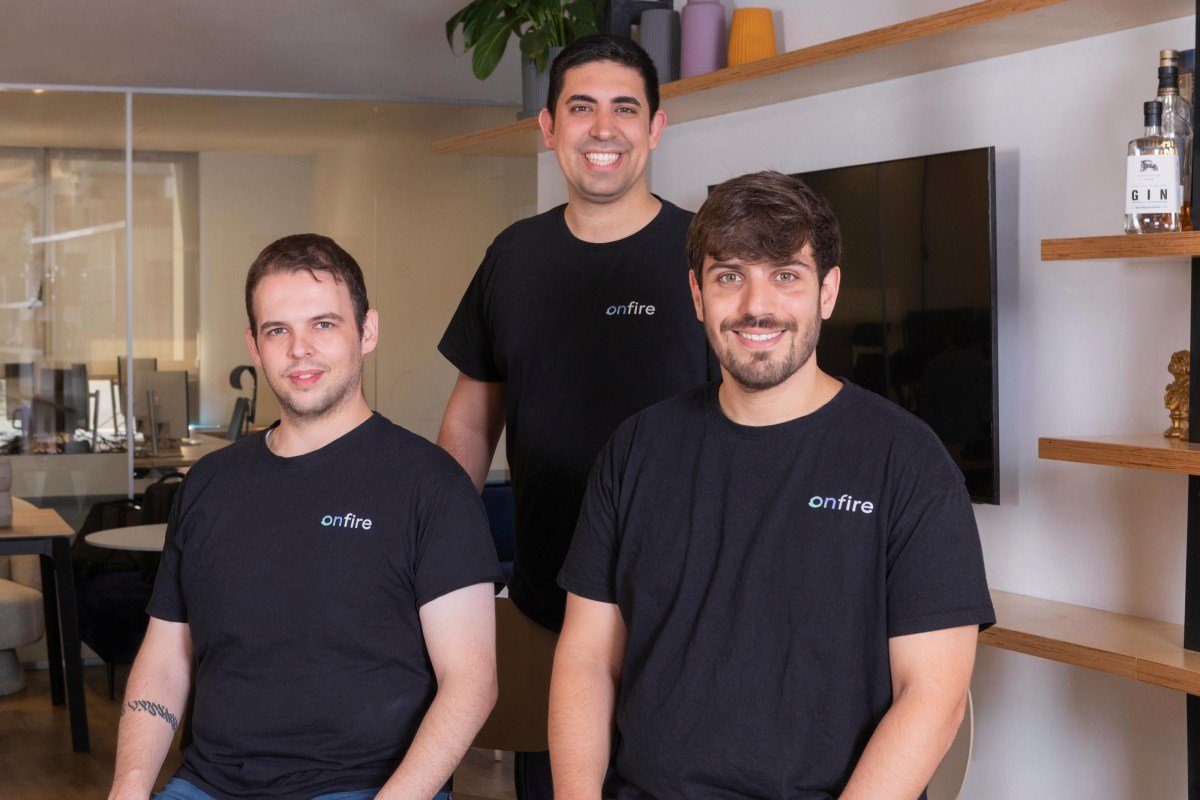
After joining the private tech sector, the trio (pictured above, from left to right: Hada, Peretz, and Shavit) saw the opportunity to use their intelligence expertise in SaaS. The startup estimates it has driven “more than $50 million in closed deals” for its clients since its beta launch 12 months ago, and says its early users include ActiveFence, Aiven, Cyera, Port, and Spectro Cloud, as well as other companies selling data, cybersecurity, FinOps, and observability solutions to technical buyers.
Still, one can’t ignore the elephant in the room: Given the founders’ intelligence background, Onfire’s trawling of public data to identify commenters’ employers is sure to raise eyebrows. But Grove Ventures managing partner Lotan Levkowitz frames the startup’s outcomes as a win-win. “Our customers are happy, and by the way, even their prospects are happy, because people pitch them with the right things at the right time,” he said.
The company hopes its vertical, data-centric focus will give it an edge over competitors. While other AI-enabled tools promise to boost enterprise sales, Peretz says one can’t do personalized outreach without something to base it off. “What set us apart is we started as a data-first company, and then we added the AI engine on top of that,” he said.
Techcrunch event
San Francisco
|
October 27-29, 2025
According to Levkowitz, Onfire is filling a gap that the venture firm had identified before it met the founders: software infrastructure companies aren’t leveraging AI in their go-to-market (GTM) strategy. “The missing piece there was the data,” he said.
Onfire comes at a time when companies are facing challenges leveraging only product-led growth for enterprise sales. Some in the industry think a new data layer is now necessary to support GTM teams, and Grove had already come to that conclusion when it connected with Onfire, Levkowitz said. He helped Onfire connect with companies his team had met while developing that thesis.
“Before we wrote a single line of code, we interviewed around 275 revenue leaders in the IT space,” Peretz told TechCrunch. The co-founders found that most companies were still deriving the majority of their revenue from direct sales efforts, but the adoption of AI tools was changing things.
They learned that buyers could benefit from using AI-based contextual tools to “do more with less.” But CISOs, CTOs, and engineering teams, traditionally considered “tough buyers,” now have to filter out more noise than ever thanks to AI tools that enable mass outreach, and context could help salespeople here.
Peretz stressed that Onfire’s solution is also about mapping signals to the context of a customer — for example, you’d need a different approach to sell a data solution to a large organization compared to a cybersecurity solution. Levkowitz says this is particularly interesting, as it means that “with every customer Onfire has, the dataset is actually getting better and better.”
That compounding data layer is what Onfire considers its moat to defend against CRM incumbents like Salesforce and HubSpot. “This verticalized approach enables them to have a very unique value proposition for these go-to-market teams of software infrastructure companies,” Levkowitz said.
Peretz said the startup plans to use its new funding to make hires in AI, R&D and sales. Its core AI system is built in Israel, where 60% of the team is based, but the “go-to-market machine” is based in New York, as the startup expects the U.S. to be one of its main markets.
