


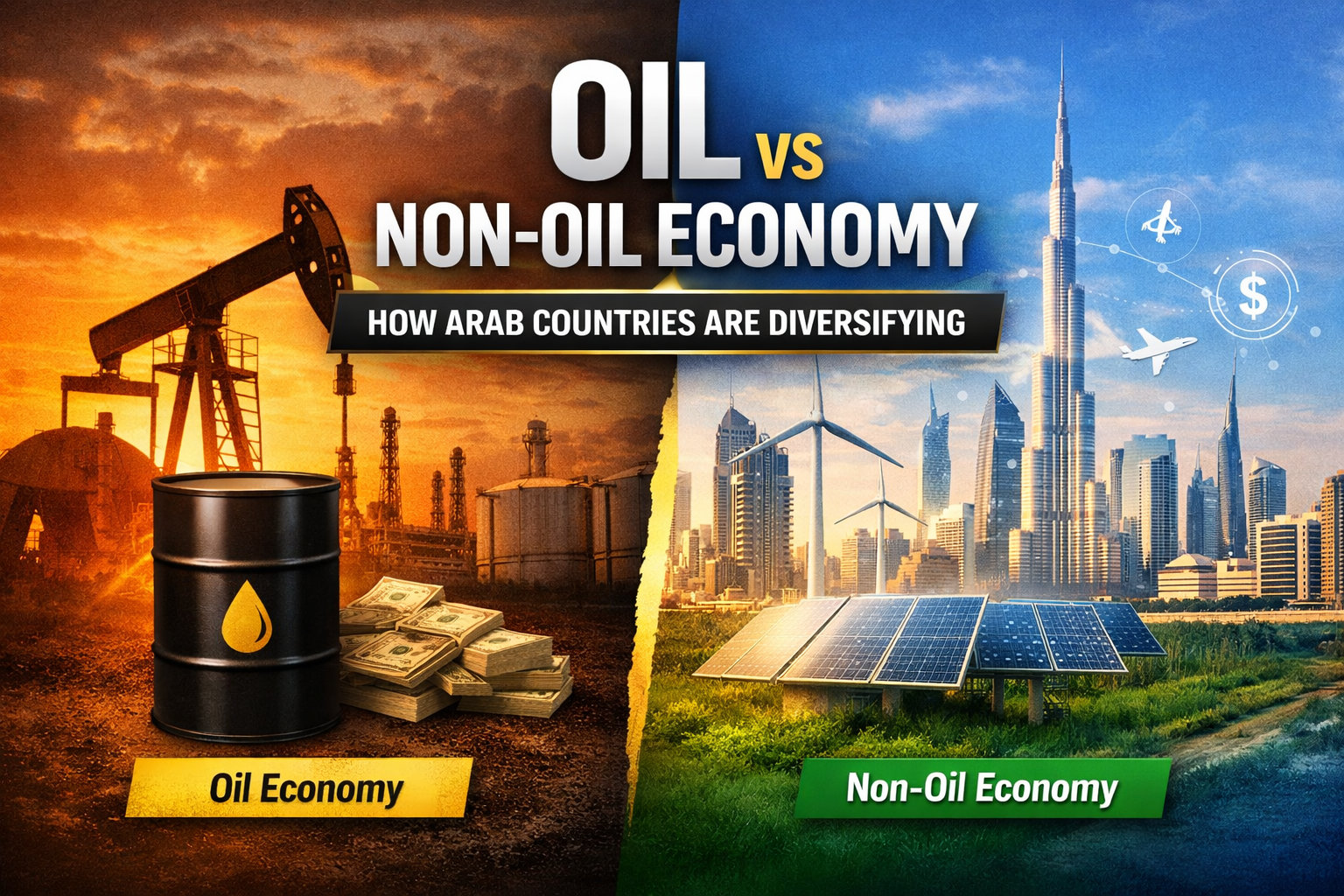
For many years, Arab countries have depended heavily on oil for their income. Countries like Saudi Arabia, UAE, and Kuwait earned most of their money from oil exports. But now, things are changing. These countries are working hard to build a non-oil economy to reduce dependence on oil and create a stable future.
In this blog, we will understand the difference between oil and non-oil economies and how Arab countries are diversifying.
🛢️ What is an Oil-Based Economy?
An oil-based economy depends mainly on oil production and exports for income. Governments earn money by selling crude oil to other countries.
✅ Key Features:
- High revenue from oil exports
- Strong government control
- Economic growth depends on oil prices
⚠️ Problems:
- Oil prices are unstable
- Limited job opportunities outside oil sector
- Risk of economic slowdown if oil demand falls
👉 Example: When oil prices drop globally, countries that depend on oil face financial problems.
🌱 What is a Non-Oil Economy?
A non-oil economy focuses on other industries like tourism, technology, finance, real estate, and manufacturing.
✅ Benefits:
- Stable and diversified income
- More job opportunities
- Long-term economic growth
👉 This is why Arab countries are now investing in different sectors.
🔄 Why Arab Countries Are Moving Away from Oil
1. 📉 Falling Oil Demand
With the rise of renewable energy (like solar and wind), global demand for oil may decrease in the future.
2. 📊 Economic Stability
Depending only on oil is risky. Diversification helps balance the economy.
3. 👨💼 Job Creation
Non-oil sectors create more jobs for young people.
4. 🌍 Global Competition
Countries want to compete globally in technology, tourism, and finance.
🌍 How Arab Countries Are Diversifying
🇸🇦 Saudi Arabia – Vision 2030
Saudi Arabia launched Vision 2030 to reduce oil dependence.
Key Areas:
- Tourism (NEOM city project)
- Entertainment industry
- Technology and innovation
🇦🇪 United Arab Emirates (UAE)
The UAE is one of the best examples of diversification.
Major Sectors:
- Tourism (Dubai is a global hub)
- Real estate
- Aviation
- Finance
👉 Today, a large part of UAE’s income comes from non-oil sectors.
🇶🇦 Qatar
Qatar is investing in:
- Sports (FIFA World Cup 2022)
- Infrastructure
- LNG (liquefied natural gas)
🇪🇬 Egypt
Egypt is focusing on:
- Manufacturing
- Agriculture
- Tourism
💼 Key Non-Oil Sectors Growing Fast
🏙️ 1. Tourism
Arab countries are building hotels, resorts, and attractions to attract international tourists.
💻 2. Technology & Startups
Startups and digital businesses are growing rapidly in cities like Dubai and Riyadh.
🏦 3. Finance & Banking
Financial services are becoming a strong source of income.
🛒 4. E-commerce
Online shopping is booming in the Middle East.
⚡ 5. Renewable Energy
Countries are investing in solar and green energy projects.
📊 Benefits of Economic Diversification
- 💰 Multiple income sources
- 📈 Stable economic growth
- 👨💼 More employment opportunities
- 🌍 Strong global position
- 🔒 Reduced economic risk
⚠️ Challenges in Diversification
Even though diversification is important, it is not easy.
❌ Challenges:
- High investment cost
- Need for skilled workforce
- Economic reforms take time
- Global competition
👉 But with strong planning, Arab countries are overcoming these challenges.
🔮 Future of Arab Economies
The future looks promising. With continuous investment in non-oil sectors, Arab countries are becoming global business hubs.
- Dubai is a global tourism and business center
- Saudi Arabia is becoming a tech and entertainment hub
- Qatar is growing in infrastructure and sports
👉 In the coming years, non-oil sectors will play a bigger role than oil.
✅ Conclusion
Arab countries are slowly moving from an oil-based economy to a diversified economy. This shift is important for long-term growth and stability. By investing in tourism, technology, finance, and renewable energy, these countries are building a stronger and more secure future.
❓ FAQs
1. What is the main difference between oil and non-oil economy?
An oil economy depends on oil exports, while a non-oil economy focuses on industries like tourism, technology, and finance.
2. Why are Arab countries reducing oil dependence?
Because oil prices are unstable and renewable energy is growing, making oil less reliable in the future.
3. Which country is leading in diversification?
The UAE is a top example, followed by Saudi Arabia with its Vision 2030 plan.
4. What sectors are growing in the Middle East?
Tourism, fintech, e-commerce, real estate, and renewable energy are growing fast.
5. Is diversification good for the economy?
Yes, it creates jobs, reduces risk, and ensures long-term economic stability.
