


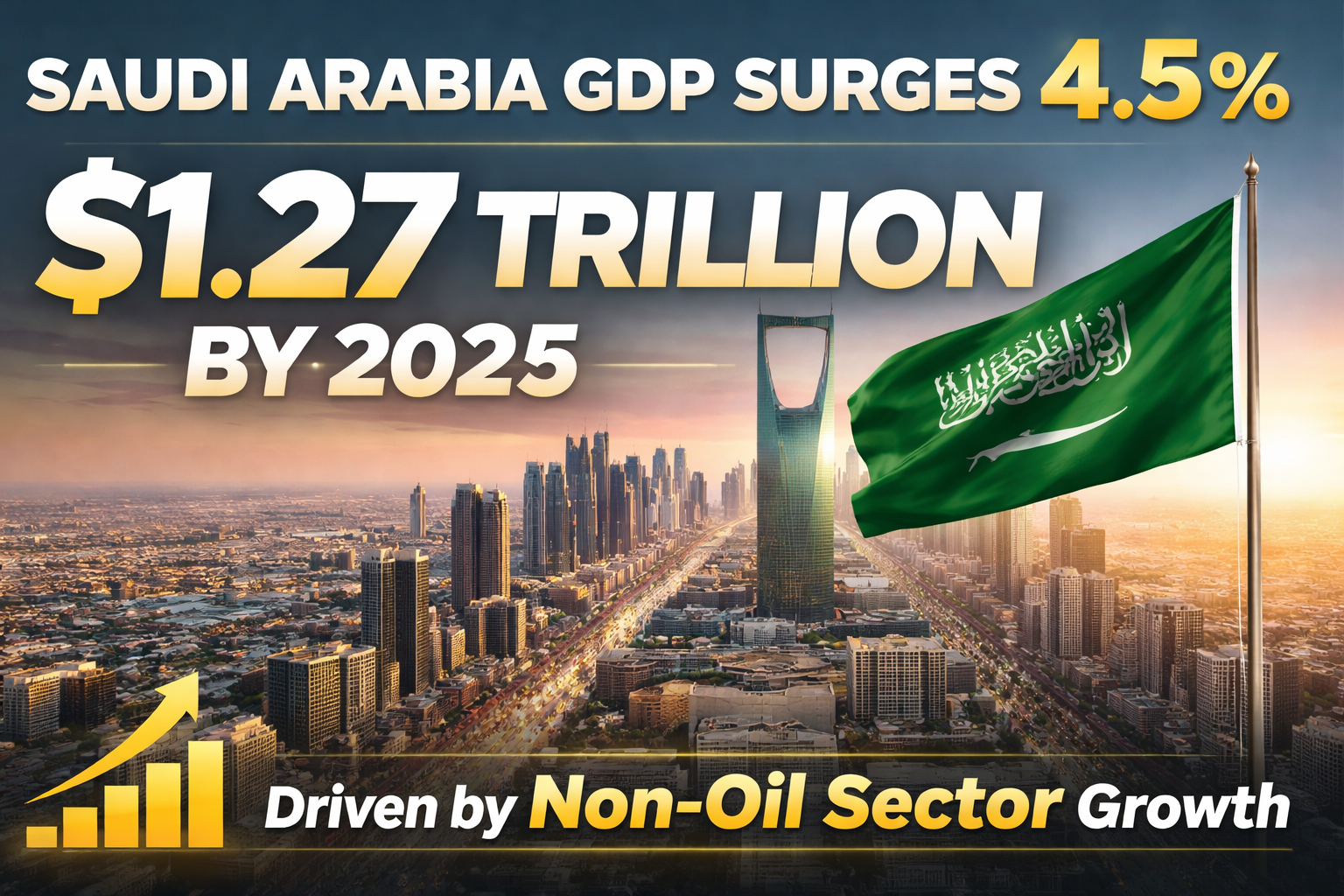
Saudi Arabia’s economy is showing strong progress as the country continues its journey toward economic diversification. In 2025, the Kingdom’s real Gross Domestic Product (GDP) reached 4.5 percent growth, pushing the total economic value to approximately $1.27 trillion. One of the most important highlights of this growth is that non-oil sectors are driving a large portion of the expansion.
For decades, Saudi Arabia’s economy depended heavily on oil exports. However, recent reforms and strategic investments are changing that picture. With the government’s Vision 2030 plan, Saudi Arabia is focusing on building a more balanced economy that includes tourism, technology, infrastructure, logistics, and manufacturing.
The latest data also shows that the fourth quarter (Q4) of 2025 maintained strong momentum with a 5 percent year-over-year (YoY) increase, proving that the country’s economic transformation is moving in the right direction.
In this article, we will explore the reasons behind Saudi Arabia’s GDP growth, the role of non-oil sectors, and what this means for the future of the Kingdom’s economy.
Understanding Saudi Arabia’s GDP Growth in 2025
Gross Domestic Product (GDP) measures the total value of goods and services produced in a country. It is one of the most important indicators of economic health.
In 2025, Saudi Arabia recorded:
- Real GDP Growth: 4.5%
- Total Economic Output: $1.27 trillion
- Q4 Growth Rate: 5% year-over-year
This growth reflects strong performance in both government and private sectors, especially outside the traditional oil industry.
The increase in GDP shows that Saudi Arabia’s economy is becoming more diversified and resilient, which is one of the main goals of the government’s long-term economic strategy.
The Growing Role of Non-Oil Sectors
One of the biggest factors behind Saudi Arabia’s economic expansion is the rapid growth of non-oil industries.
These sectors include:
- Tourism
- Technology
- Construction
- Logistics
- Manufacturing
- Entertainment
- Financial services
For many years, oil revenues accounted for the majority of the country’s income. But now, non-oil sectors are contributing a larger share to GDP growth.
Government investments in infrastructure projects, smart cities, and tourism initiatives are helping to create new opportunities for businesses and investors.
Major projects such as NEOM, The Red Sea Project, and Qiddiya are attracting global attention and boosting economic activity.
Vision 2030 and Economic Diversification
Saudi Arabia’s economic transformation is largely guided by the Vision 2030 strategy, which aims to reduce the country’s dependence on oil.
Key goals of Vision 2030 include:
- Increasing non-oil revenue
- Creating more private sector jobs
- Attracting foreign investment
- Expanding tourism
- Developing advanced industries
Since the launch of Vision 2030, the Kingdom has implemented several reforms that encourage entrepreneurship and international partnerships.
These reforms include:
- Business-friendly regulations
- Investment incentives
- Infrastructure development
- Digital transformation
As a result, Saudi Arabia has become one of the fastest-growing economies in the region.
Strong Economic Momentum in the Fourth Quarter
The fourth quarter of 2025 recorded 5 percent year-over-year growth, which indicates strong economic momentum toward the end of the year.
Several factors contributed to this performance:
Increased Government Spending
The Saudi government continues to invest heavily in infrastructure, energy transition projects, and tourism development.
Expanding Private Sector
Private companies are playing a bigger role in economic growth. New businesses, startups, and international partnerships are boosting economic activity.
Higher Consumer Spending
As employment opportunities increase, consumer confidence and spending also rise, supporting retail and service industries.
Tourism Growth
Saudi Arabia is opening its doors to international tourists. Events, cultural festivals, and sports competitions are attracting visitors from around the world.
Investment Driving Economic Expansion
Foreign and domestic investments are playing a key role in Saudi Arabia’s economic growth.
The government is actively encouraging global investors to participate in major development projects. Saudi Arabia has introduced several initiatives to make the country more attractive to investors, such as:
- Simplified licensing procedures
- Tax incentives
- Investment-friendly policies
- Special economic zones
The Public Investment Fund (PIF) is also investing billions of dollars in strategic sectors to accelerate economic diversification.
These investments are helping to build a modern economy that is less dependent on oil revenues.
The Impact of Tourism and Entertainment
Tourism has become one of the fastest-growing industries in Saudi Arabia.
The government plans to attract over 100 million tourists annually by 2030, and several projects are already contributing to this goal.
Major tourism initiatives include:
- Red Sea luxury resorts
- Cultural heritage sites
- Mega entertainment cities
- International sporting events
The growth of tourism not only increases revenue but also creates millions of new jobs for Saudi citizens.
The entertainment industry, which was limited in the past, is now expanding rapidly with concerts, festivals, and global sporting events.
Digital Transformation and Technology Growth
Saudi Arabia is also investing heavily in technology and digital infrastructure.
The Kingdom aims to become a major technology hub in the Middle East. Investments in artificial intelligence, cloud computing, and smart city projects are supporting economic growth.
Technology startups are receiving support through government initiatives and venture capital programs.
Digital transformation is improving productivity across many sectors, including finance, healthcare, education, and logistics.
Challenges Facing the Saudi Economy
Although the outlook is positive, Saudi Arabia still faces several challenges.
Oil Market Volatility
Even though non-oil sectors are growing, oil revenues still play a major role in government income.
Global Economic Uncertainty
Changes in global markets, inflation, and geopolitical tensions can affect economic stability.
Workforce Development
Saudi Arabia is working to improve education and training programs to prepare its workforce for modern industries.
Despite these challenges, economic reforms and diversification efforts are helping the country build a stronger and more sustainable economy.
Future Outlook for Saudi Arabia’s Economy
Experts believe Saudi Arabia’s economy will continue to grow in the coming years.
Key factors supporting future growth include:
- Continued investment in mega projects
- Expansion of tourism and entertainment
- Growth of technology and innovation
- Increased foreign investment
- Development of renewable energy
If the current momentum continues, Saudi Arabia could become one of the most diversified and competitive economies in the Middle East.
The progress made in 2025 demonstrates that the Kingdom is moving closer to achieving its long-term economic goals.
Conclusion
Saudi Arabia’s 4.5 percent GDP growth in 2025, reaching $1.27 trillion, highlights the success of the country’s economic transformation efforts. The strong 5 percent growth in the fourth quarter shows that the momentum is continuing.
The most significant aspect of this growth is the increasing contribution of non-oil sectors, which are helping reduce dependence on oil revenues.
With ongoing investments in tourism, technology, infrastructure, and innovation, Saudi Arabia is building a more diversified and sustainable economy.
As Vision 2030 continues to guide development, the Kingdom is expected to play an even more important role in the global economy in the years ahead.
FAQs
1. What was Saudi Arabia’s real GDP growth in 2025?
Saudi Arabia’s real GDP grew by 4.5 percent in 2025, reaching a total economic output of around $1.27 trillion.
2. What drove Saudi Arabia’s economic growth in 2025?
The growth was mainly driven by non-oil sectors such as tourism, construction, technology, and services.
3. How strong was Saudi Arabia’s economy in the fourth quarter of 2025?
In the fourth quarter of 2025, the economy grew by 5 percent year-over-year, showing strong economic momentum.
4. What is Vision 2030?
Vision 2030 is Saudi Arabia’s long-term economic plan aimed at diversifying the economy and reducing dependence on oil.
5. What industries are growing fastest in Saudi Arabia?
Some of the fastest-growing industries include tourism, entertainment, technology, logistics, and infrastructure development.
