


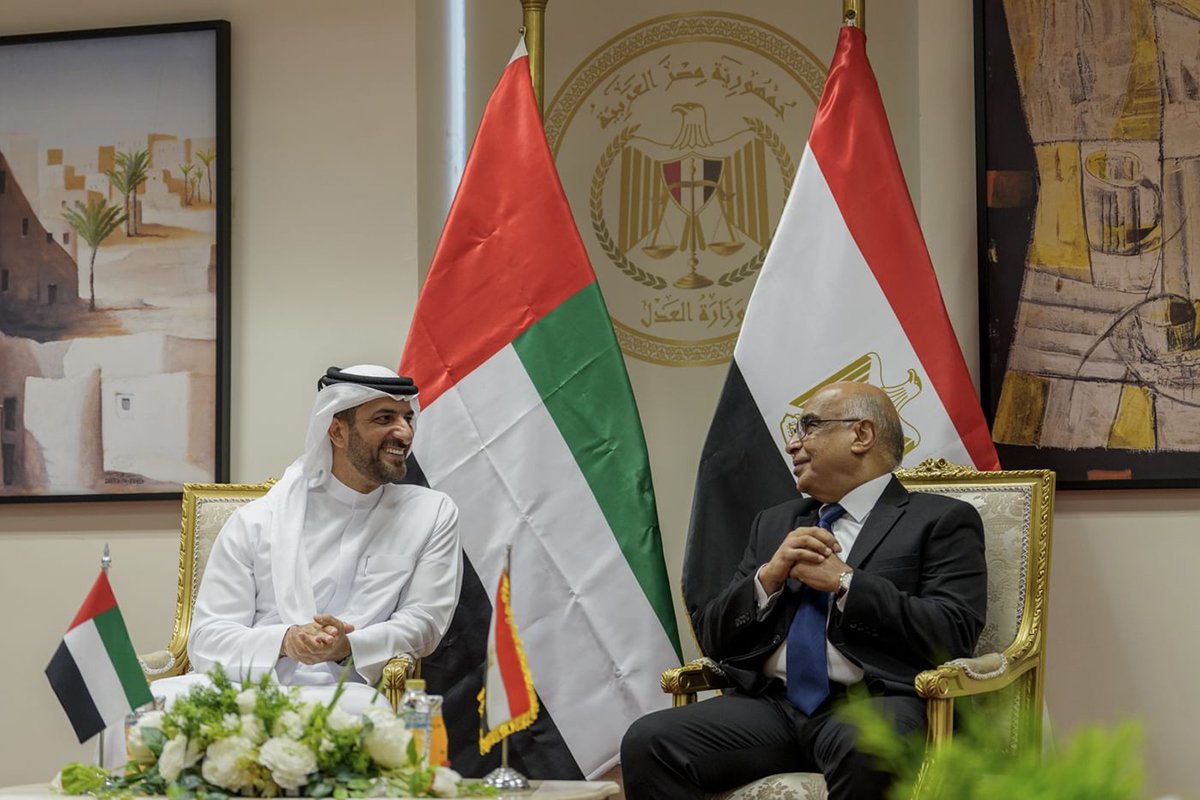
Sheikh Sultan bin Ahmed Al Qasimi, Deputy Ruler of Sharjah and Chairman of the Judicial Council, has met senior Egyptian officials and toured major cultural and religious sites in Cairo’s New Administrative Capital during a high-profile visit aimed at deepening ties between the two countries, the Emirates News Agency (WAM) reported.
Judicial cooperation talks
On Sunday, Sheikh Sultan held talks with Adnan Fanjari, Egypt’s Minister of Justice, in the ministry’s offices in the New Administrative Capital. Discussions centred on strengthening cooperation between Sharjah’s Judicial Council and Egypt’s Ministry of Justice, with Sheikh Sultan underscoring the UAE’s interest in drawing on Egypt’s extensive legal experience, WAM said.
The Deputy Ruler of Sharjah praised Egypt’s judicial reforms, including efforts to modernise court systems and update legislation to meet contemporary needs. Both sides highlighted the importance of exchanging expertise to improve court effectiveness and enhance the skills of legal professionals.
Sheikh Sultan toured the ministry’s facilities, including its library, which holds legal texts in Arabic and English as well as historical books more than a century old. He also visited employee and nursery facilities before concluding the meeting with an exchange of gifts and a group photograph, according to WAM.
Visit to Islamic Cultural Centre
Later in the day, Sheikh Sultan visited Egypt’s new Islamic Cultural Centre, a sprawling complex covering 467,000 square metres in the New Administrative Capital. He was received by Osama Al-Azhari, Egypt’s Minister of Awqaf, Justice Minister Fanjari, and Khaled Abbas, head of the Administrative Capital for Urban Development, WAM said.
Sheikh Sultan praised the centre’s role in promoting Islamic culture and values, describing it as an institution that supports Islam and Muslims, fosters virtuous principles, and strengthens Egypt’s civilisational influence. He commended the architectural design, which blends heritage with modernity, including features inspired by Mamluk traditions.
At an observation deck, Sheikh Sultan viewed the Government District, including the Presidential Palace and legislative buildings. He also toured the House of the Quran beneath the mosque’s plaza, where artefacts linked to Egypt’s most renowned Quranic reciters are displayed.
The centre’s Quranic halls were highlighted during the visit. Each of the 30 rooms is engraved with a full section of the holy text, supported by audio recitations to aid memorisation. Sheikh Sultan also viewed historic Qurans, decorative murals, and the centre’s master plan.
The visit concluded at the Grand Mosque of Egypt, which anchors the cultural complex. With a capacity of about 137,000 worshippers, it is Egypt’s largest mosque and the third largest in the world. Its two 148-metre minarets and 500-tonne central dome were noted as engineering and architectural highlights, while the mosque’s wooden pulpit is recognised by Guinness World Records as the largest of its kind, WAM said.
Opera House and City of Arts and Culture
Sheikh Sultan also visited the Opera House in Cairo’s New Administrative Capital, located in the City of Arts and Culture, which is described as the largest cultural and artistic hub in the Middle East.
According to WAM, the Deputy Ruler of Sharjah toured the opera hall, which seats 2,200 people across four levels and can accommodate international performances from orchestras and ballet to circuses. The venue includes two movable towers to expand staging space.
He was shown the 1,200-seat music hall, which features a 4,044-pipe organ designed to international standards, and the drama hall, which has 650 seats and is equipped for plays, talk shows, and live broadcasts with translation services.
Sheikh Sultan admired the hand-painted murals and interior design, and later wrote in the guestbook: “I was honoured to visit the City of Arts and Culture. I extend my sincere thanks and appreciation to all those responsible for this magnificent cultural landmark.” The visit ended with a group photograph and an exchange of commemorative shields.
Deepening UAE-Egypt ties
The UAE and Egypt maintain strong ties across economic, political and cultural sectors, with judicial cooperation and shared cultural projects featuring prominently in recent years.
While WAM did not announce any specific agreements following the meetings, Sheikh Sultan’s emphasis on knowledge exchange in the legal field and his visits to Egypt’s flagship cultural landmarks underline Sharjah’s interest in supporting institutional development and fostering mutual understanding.
The New Administrative Capital, where all the visits took place, is a $58 billion mega-project launched by Egypt to ease congestion in Cairo and serve as the seat of government and culture. By showcasing its judicial, cultural and religious facilities, the capital has become a focal point for Egypt’s efforts to project modernisation and heritage simultaneously.
