


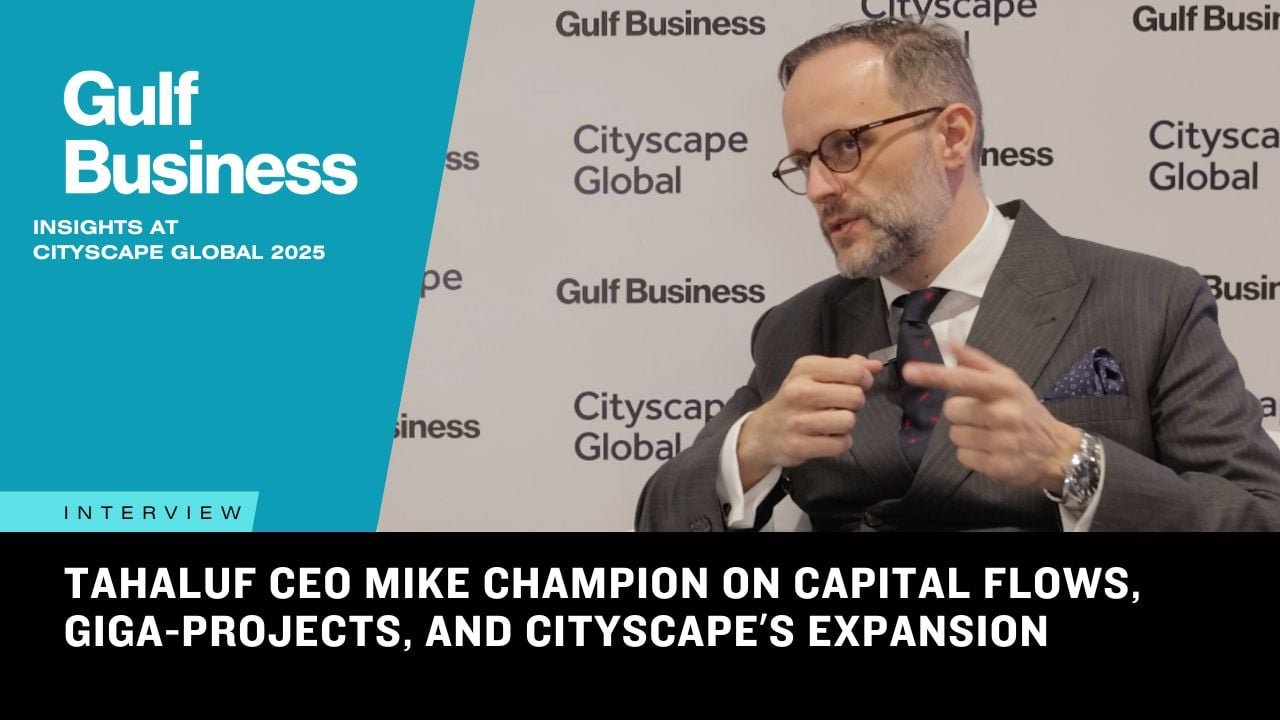

Tahaluf CEO Mike Champion talking to Gulf Business at Cityscape Global 2025
Cityscape Global has rapidly become one of the most influential real estate platforms worldwide, and at the centre of this transformation is Tahaluf — the events company behind several of Saudi Arabia’s most high-impact convenings, including LEAP, Black Hat, DeepFest, and Money20/20. Speaking with Gulf Business at the 2025 edition in Riyadh, Mike Champion, CEO of Tahaluf, detailed how the company is reshaping event standards in the Kingdom and aligning them with Saudi Arabia’s Vision 2030 agenda.
Champion made it clear that the event’s success is rooted in strategic alignment with national priorities. “All of the Tahaluf events that we do deliberately align with the strategic priorities of the government,” he said. From AI and cybersecurity to biotech, pharmaceuticals, and medical innovation, Tahaluf’s event portfolio mirrors the Kingdom’s push to build competitive, globally connected industries.
The 2025 edition of Cityscape Global also reflects Saudi Arabia’s intensifying focus on attracting global investment. Champion pointed to the investor forum running in parallel with the exhibition. “You have trillions of dollars — literally trillions of dollars — of real estate assets under management represented by chief investment officers and serious investors… looking at mega projects and giga projects, funds, and how they can deploy those funds within Saudi.”
This shift toward investment-led convening marks a clear evolution from the event’s previous iterations. “We’ve only done three editions,” he said. “Within three years, this event is now three times larger than the largest ever Cityscape that’s happened in any other market.”
Scaling at speed: Lessons from three editions
Tahaluf’s rapid growth hasn’t been without challenges. Champion openly acknowledged the difficulties of scaling both events and organisational capacity, but highlighted the 96% employee retention rate as the anchor to the company’s momentum.
“When you’re scaling a company as fast as we have been — from a couple of people only a few years ago to next year going into 470 to 500 people — you tend to lose a lot of people on the way, but we haven’t lost that many,” he said. “That continuity of talent ensures that you don’t get a repetition of silly mistakes.”
He referenced operational learnings, particularly from LEAP, where unprecedented attendance created logistical challenges. “We learned from that success that caused a problem,” Champion said. The solution included building a third hall, adding 5,000 parking spaces, and widening roads. “Now we don’t have a parking problem or a traffic problem like we did.”
A significant part of continuous improvement comes from year-round engagement with ministries, regulators, and private-sector leaders. “We meet with the government entities responsible for property, real estate, regulation… They guide us. There’s a lot of research that happens.”
The ‘festivalisation’ of business events
One of Champion’s strongest points was the shift in how professional events are designed and experienced. “Festivalisation is where you turn an event from being something that nobody wants to go to, but they’re forced to by their boss, to one where people are begging their boss to go to.”
He argues that many global organisers prioritise profitability over market relevance. Tahaluf has chosen a different route: “We’ve trusted that the market and what they want should have that service to a really high standard — and then the profit should follow.”
This philosophy has helped Tahaluf build flagship events that command significant government participation and decision-making influence. “Cityscape — there is no other event of this size in the property market or in real estate,” Champion said. LEAP, he added, is now unmatched in global attendance for its category.
The road ahead: New mega-events, new headquarters, and global expansion
Tahaluf’s ambitions for the next five to ten years reflect both confidence and long-term planning.
From 2020 to 2025, the company grew annual revenue from only a few million dollars to more than $200 million. “We’ve seen this year 36–37% revenue growth,” Champion said. “Next year, I think we’ll probably see healthy double-digit revenue growth as well.”
Half of future growth, he noted, will come from new event launches. “I’m in final discussions with what I would refer to as two genuine, globally important mega event brands… And there are another four or five events of substance that have a big opportunity to grow.”
Tahaluf’s economic impact reached $17.6 billion between 2023 and 2025 — “more than the Qatar World Cup, more than the Summer Olympics in Paris,” Champion emphasised. With rising global business tourism into Saudi Arabia, he expects this impact to accelerate.
The company is also preparing to move into a new 4,750 sq. m headquarters in Riyadh. “It will be one of Informa’s premier offices worldwide… such is how important the Saudi market is to Informa and why Informa has been involved in the Saudi market for almost a decade.”
Cityscape Global 2025 reflects the Kingdom’s momentum as it becomes a global centre for real estate investment, innovation, and large-scale development. For Tahaluf, the event is both a product and symbol of Saudi Arabia’s new economic trajectory — a fast-scaling, internationally connected, high-impact platform built around Vision 2030’s ambitions.
Champion summarised it best: “The government here have very high standards. When you meet those high standards, when you meet the challenge of delivering that for them, then that begets more work and more opportunity.”
Cityscape Global — and Tahaluf itself — appears poised to capture that opportunity at unprecedented scale.
