


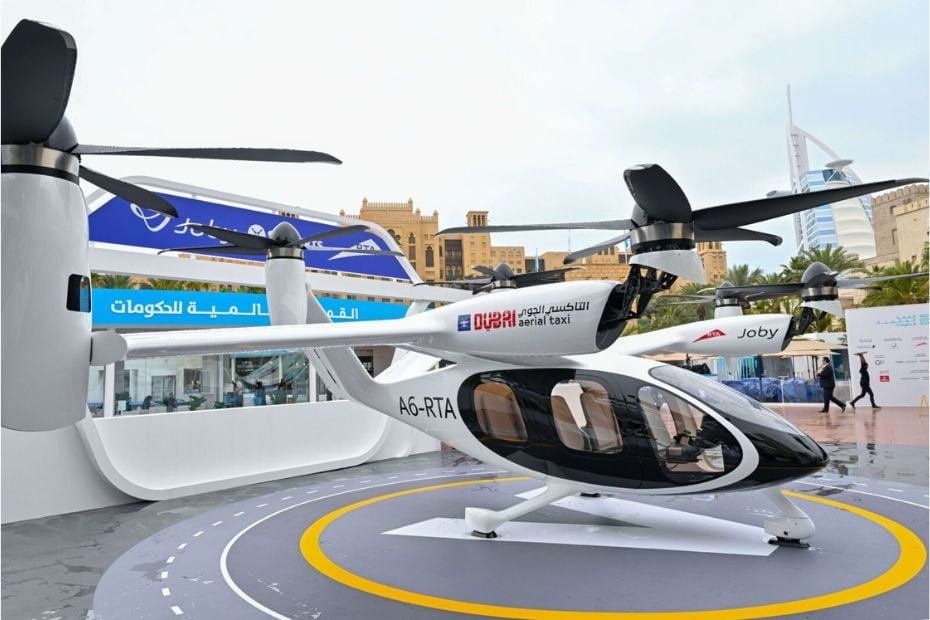

Image credit: WAM/Website
The UAE is accelerating its leadership in advanced aerial mobility (AAM) by shaping one of the world’s most forward-looking regulatory frameworks for air taxis and drone logistics. The initiative, jointly led by the Technology Innovation Institute (TII) and ASPIRE, both operating under the Advanced Technology Research Council (ATRC), is being developed in collaboration with the General Civil Aviation Authority (GCAA).
Read more-Dubai’s aerial taxi services: RTA tests region’s first flight
Overseen by the Council for Autonomous Systems, the programme focuses on designing data-driven, simulation-based regulations to safely integrate both crewed and uncrewed aerial vehicles into national airspace. The effort positions the UAE among a select group of nations pioneering structured frameworks for the next generation of air transportation, according to the UAE’s national news agency, WAM.

Field simulations are currently underway across Yas Island, Zayed Port, and Abu Dhabi International Airport, strategic locations chosen as future vertiport hubs. Supported by advanced modelling tools developed with the California Institute of Technology (Caltech), these tests study wind patterns, safety limits, and flight dynamics to guide the creation of efficient, safe air corridor designs.
The findings from these real-world trials will help shape operational standards for urban air mobility, ensuring that emerging aerial transport systems integrate smoothly within city environments.
Regulations for a new era
Eng Aqeel Ahmed Al Zarooni, assistant director-general for Aviation Safety Affairs at the GCAA, emphasised the importance of adapting to the rapid evolution of aviation.
“As aviation continues to evolve, our regulatory frameworks must evolve with it,” he said. “Through this collaboration with TII and ASPIRE, we are laying the foundation for the safe and scalable integration of next-generation aerial mobility, ensuring harmony between manned and unmanned air traffic systems in support of our vision for smart, connected cities.”
Balancing innovation and safety
Dr Najwa Al Araj, CEO of the Technology Innovation Institute, noted that technology alone cannot drive breakthroughs in urban air mobility.
“It must be accompanied by forward-looking regulations that address the complexities of autonomous flight,” she said.
Echoing this sentiment, Andrew Strefford, executive director at ASPIRE, highlighted that trust and safety underpin the success of urban air mobility.
“Policies and regulations are essential to its adoption,” he said. “What we are establishing in Abu Dhabi lays the foundation for global confidence in how future cities will communicate and operate their urban and suburban airspaces, opening up new economic opportunities across mobility and logistics sectors.”
The project’s four workstreams span the design of safe air corridors, vehicle separation standards, coordination between traditional and unmanned air traffic systems, and regulatory advisory support.
By blending advanced research, simulation technology, and cross-sector collaboration, the UAE is setting new global benchmarks for the governance of aerial mobility. The initiative strengthens Abu Dhabi’s position as a global testbed for next-generation transport regulation, and as a model for the smart cities of the future.
