


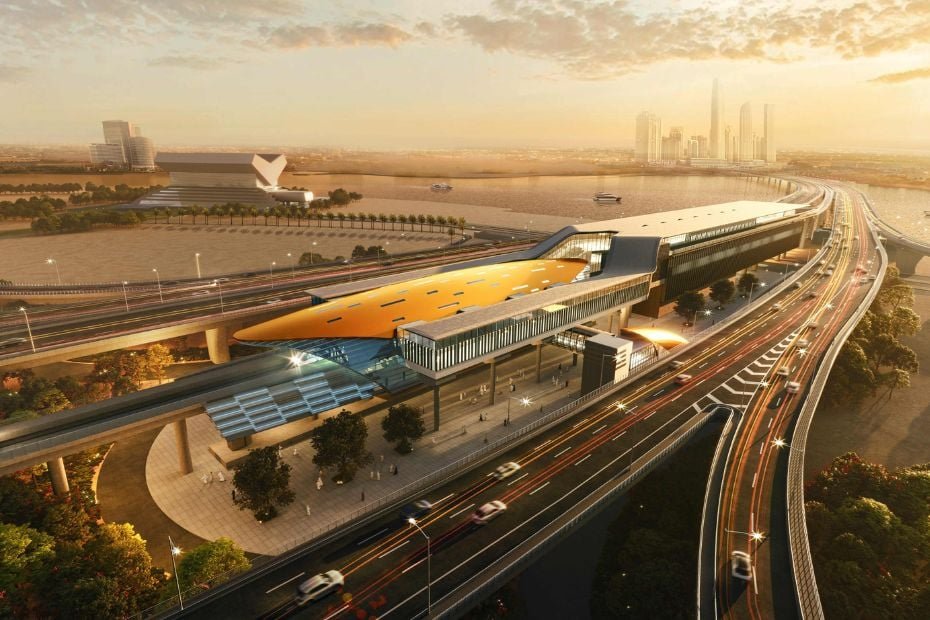

Image credit: Dubai Media Office/X account
Dubai’s Roads and Transport Authority (RTA) has achieved a major milestone in the development of the Dubai Metro Blue Line, with 10 per cent of the project’s construction now complete. The 30-kilometre metro extension, featuring 14 stations, reached this mark just five months after its groundbreaking ceremony in June 2025.
More than 500 engineers and experts, supported by 3,000 workers across 12 sites, are working to deliver what RTA describes as a world-class transit link connecting the emirate’s key residential, academic, economic, and tourism zones, a Dubai Media Office report said.
Mattar Al Tayer, director general and chairman of the Board of Executive Directors of RTA, confirmed that construction is progressing on schedule. The authority expects 30 per cent completion by the end of 2026 and has targeted September 9, 2029 for the official opening of the line, according to a Dubai Media Office report.
#RTA continues works on the #DubaiMetro Blue Line project, one of its most strategic projects. The line connects the Red and Green Lines of the Dubai Metro and serves areas expected to accommodate around one million residents by 2040. The project supports the objectives of the… pic.twitter.com/KtE48gz78D
— RTA (@rta_dubai) November 9, 2025
Read more-Dubai Metro Blue Line: How will it change commuting in the city
Al Tayer highlighted the project’s strategic significance within Dubai’s long-term urban and economic vision.
“The Dubai Metro Blue Line is one of RTA’s most strategic projects. The line connects the Red and Green Lines and serves districts expected to house nearly one million residents by 2040,” he said.
تواصل #هيئة_الطرق_و_المواصلات العمل على تنفيذ مشروع الخط الأزرق لـ#مترو_دبي وصولاً إلى الافتتاح الفعلي في العام 2029. يمتد الخط الأزرق لمترو دبي باتجاهين، الأول يمتد من محطة الخور الانتقالية على الخط الأخضر، في منطقة الجداف، مروراً بدبي فستيفال سيتي، ومنطقة مرسى خور دبي، ومنطقة… pic.twitter.com/sxK9pjbKFf
— RTA (@rta_dubai) November 9, 2025
The Blue Line will also enable direct journeys between Dubai International Airport and major urban areas in just 20 minutes.
The project directly supports the Dubai Urban Plan 2040, linking the city’s fifth urban centre to the metro network, enhancing accessibility and reinforcing the “20-minute city” concept, allowing residents and visitors to access over 80 per cent of essential services within 20 minutes of travel.
Economic and social impact
According to RTA estimates, the total economic benefits of the Blue Line are projected to exceed Dhs56.5bn by 2040, driven by savings in time, fuel, and accident-related fatalities. The project is also expected to raise land and property values by up to 25 per cent around metro stations and reduce traffic congestion by 20 per cent along the serviced corridors.
Al Tayer added that the project aligns closely with Transit-Oriented Development (TOD) principles and Dubai’s Economic Agenda (D33), both designed to drive sustainable urban growth and economic competitiveness.
Commitment to safety and quality
RTA has underscored its commitment to the highest occupational safety and construction quality standards. The project’s consortium, including global experts and Emirati engineers, has so far completed over three million work hours without recording a single fatality.
“This reflects RTA’s strict adherence to world-class safety practices, robust field supervision systems, and integrated project management frameworks,” Al Tayer said.
Currently, construction activity is spread across 12 major work sites. The overall project progress, now at 10 per cent, demonstrates consistent advancement in line with planned schedules.
To maintain the city’s traffic flow, RTA has implemented 11 traffic diversions so far, with more than 10 additional diversions planned in upcoming phases.
Engineering teams have completed over 260 deep foundations and begun excavation work exceeding 400,000 cubic metres at key sites, including International City (1), (2), and (3). Several columns have already been erected at the Dubai Academic City station, and retaining walls are now taking shape at underground stations such as International City (1).
“These milestones allow us to expand excavation and accelerate progress in subsequent construction stages,” Al Tayer explained.
In a bid to maintain strict control over construction quality and logistics, the project consortium has established two ready-mix concrete plants and two precast element yards in Al Ruwayyah 3 and International City.
This proactive approach enables RTA to manage quality, streamline material supply chains, and shorten overall construction timelines. “It reflects our strategy of maintaining direct oversight and efficiency in every phase of the project,” Al Tayer said.
Boosting connectivity and quality of life
The Dubai Metro Blue Line aims to significantly expand the city’s public transport capacity while reducing reliance on private vehicles. By linking key business, residential, and educational hubs, it will improve overall urban mobility and environmental sustainability.
The line will extend in two directions:
- The first route, spanning 21 kilometres, begins at Creek Interchange Station on the Green Line in Al Jaddaf and passes through Dubai Festival City, Dubai Creek Harbour, and Ras Al Khor Industrial Area before reaching International City (1). From there, it continues through International City (2) and (3), Dubai Silicon Oasis, and terminates at Dubai Academic City. This segment includes 10 stations, one of which, International City (1), will serve as an underground interchange.
- The second route, stretching 9 kilometres, starts at Centrepoint Interchange Station on the Red Line in Al Rashidiya and passes through Mirdif and Al Warqa before linking to International City (1). It includes four stations.
The project also features the development of a depot and maintenance facility in Al Ruwayyah 3 to support operations and rolling stock maintenance.
Emaar Station: A new architectural icon
Among the project’s standout features is the Emaar Station, which will become the world’s highest metro station at 74 metres tall and 38 metres wide. Covering 11,000 square metres, it is designed to handle 240,000 passengers per day by 2040, with initial daily ridership expected to exceed 70,000.
Serving the 40,000 residents of Dubai Creek Harbour, the station’s striking architecture blends futuristic design with environmental harmony. Its expansive façade allows natural light to illuminate platform levels during the day, while at night, a bespoke lighting design transforms it into a glowing landmark visible across the skyline.
“The Emaar Station will stand as a luminous beacon, an architectural statement symbolising Dubai’s dynamic growth and commitment to smart mobility,” said Al Tayer.
Community engagement and transparency
In keeping with its philosophy of public engagement and transparency, RTA has rolled out a proactive communication strategy to keep residents informed about construction progress, road diversions, and milestones.
Dedicated teams are conducting field surveys and awareness campaigns across neighbourhoods near the Blue Line’s alignment. The initiative aims to build trust and provide real-time updates through digital platforms, local media, and social channels.
To ensure consistent dialogue, RTA has launched a Customer Council programme, organising regular community gatherings in affected areas to address feedback and questions. The first such session was held in October, covering Mirdif and Al Warqa, where residents were briefed on upcoming construction activities and traffic management plans.
The communication plan underscores RTA’s emphasis on maintaining a strong connection with the public while implementing one of Dubai’s most ambitious infrastructure projects.
As work accelerates across multiple sites, the Dubai Metro Blue Line stands as a flagship infrastructure project aligned with Dubai’s broader 2040 development blueprint.
It embodies the city’s ambition to expand sustainable mobility, boost economic efficiency, and improve overall quality of life for residents and visitors alike. When completed in 2029, the Blue Line will not only enhance connectivity between the city’s major economic zones but also strengthen Dubai’s reputation as a global model for integrated, future-ready transport systems.
