


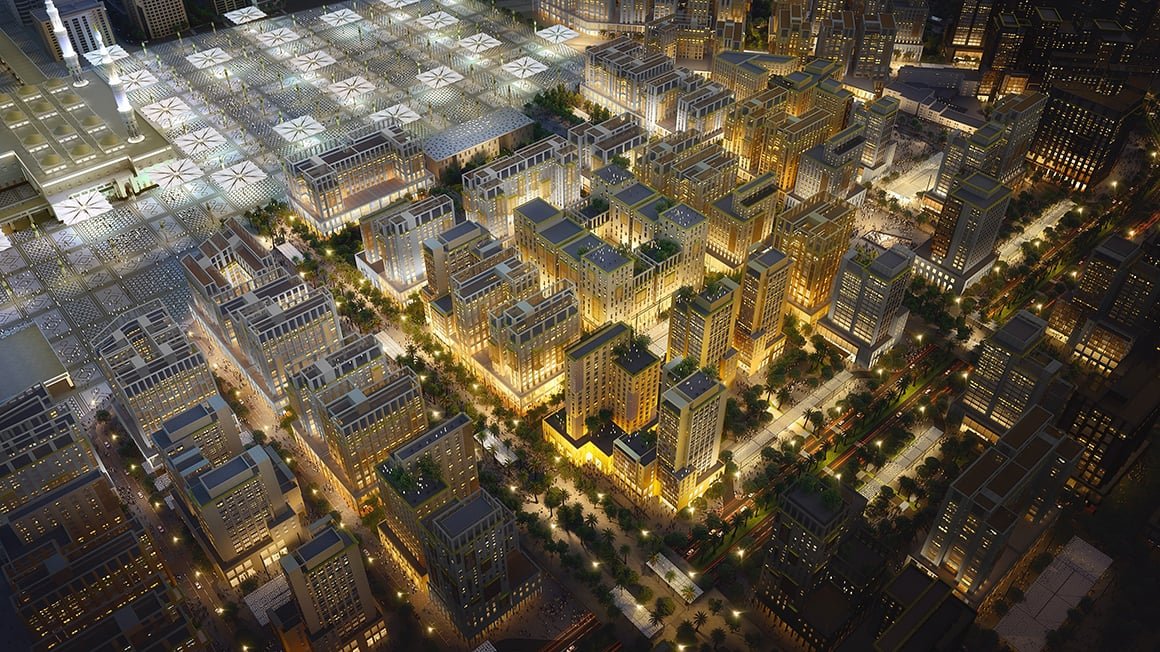

Rua Al Madinah (Image: Supplied by Accor)
The city of Madinah in Saudi Arabia is rapidly redefining itself as a prime business and investment hub, driven by a sweeping programme of development projects, infrastructure expansion, regulatory reforms and global investment outreach. With 224 initiatives currently underway, covering more than 30 million square metres and exceeding SAR200bn in value, the region is positioning itself for a new era of sustainable growth. Meanwhile, a nine-point competitive advantage framework and landmark capital-market reforms are opening the door to foreign investors as never before. Together, these moves reflect both the local ambition of Madinah and the broader objectives of Saudi Vision 2030 to diversify the economy, boost private-sector participation and raise the kingdom’s regional economic standing.
According to a report issued by the Madinah Chamber of Commerce and Industry, a total of 224 development projects are currently underway in the region. These comprise 15 government-led projects, 10 semi-government initiatives and 199 private-sector ventures, covering more than 30 million m² of investment-land. The total value of these projects exceeds SAR200bn, underlining the scale and economic significance of the programme, a Saudi Press Agency report said.
Read more-Foreigners owning property in Saudi: The rules you need to know
The bulk of activity is in the commercial sector, which accounts for 162 ventures, roughly 80 per cent of the total project count. Other highlighted segments include 20 mixed-use residential & commercial developments, 11 health-sector projects, eight standalone residential projects, seven education projects, seven tourism and entertainment initiatives, five religious-purpose projects, four public-utility schemes and two corporate-projects.
Crucially, the rollout is expected to generate 125,722 new job-opportunities in the region, supporting national efforts to reduce unemployment and raise the participation of Saudi talent in economic development. These large-scale projects offer business-community entry points, act as engines of regional growth and enhance Madinah’s attractiveness as both an investment destination and a quality-of-life destination for residents and visitors alike.
9 competitive advantages that make Madinah stand out
Beyond the hard numbers, the Madinah Chamber’s research confirms that the region enjoys nine distinctive competitive advantages that stack the deck in favour of local and foreign investors.
These advantages include generous investment incentives and facilities spanning manufacturing, tourism and advanced technologies; multi-year tax exemptions; full foreign-ownership rights in most sectors; and streamlined regional licensing procedures via a unified investment-system. The region also boasts abundant mineral reserves and large agricultural lands, date production alone exceeds 344,000 tons annually across premium varieties. Infrastructure strengths are equally noteworthy: the region hosts multiple international airports (including Prince Mohammad bin Abdulaziz International Airport in Madinah, AlUla International Airport, and Prince Abdul Mohsen bin Abdulaziz Airport in Yanbu), together serving over 11 million passengers annually. The logistics network is reinforced by key ports (Yanbu Commercial Port handles 20 million tonness of goods and 1.5 million containers; King Fahd Industrial Port manages 15 million tonnes and 400,000 containers) and the Haramain High‑Speed Train, which ferries more than 1.5 million passengers annually.
Another standout asset is the Madinah Industrial City, built on roughly 10 million m² and the home to 540 factories, around 4.6 per cent of the Kingdom’s total industrial facilities, making it a cornerstone of Madinah’s industrial and investment ecosystem. Together, these factors signal that Madinah isn’t just another regional city, it is a strategically engineered investment zone aligned with national-diversification goals.
Capital-market reforms open doors for foreign investment
In January 2025, the Capital Market Authority (CMA) announced that foreign investors can now participate in Saudi-listed companies that own real-estate assets in the cities of Makkah and Madinah. The move forms part of a broader drive to enhance capital-market appeal, boost liquidity, and channel foreign capital into key developmental initiatives.
Under the new rules, non-Saudi natural and legal persons may hold up to 49 per cent of shares in a listed company owning real estate in Makkah or Madinah; direct shareholding by strategic foreign investors is excluded from this allowance. The reforms also allow listed Saudi companies to acquire ownership, easement, or usufruct rights over properties used for headquarters or branch offices in Makkah and Madinah, so long as those properties serve designated operational uses and comply with relevant laws. These regulatory adjustments sit alongside earlier measures that opened the Saudi market to resident foreign investors, swap-agreements, qualified foreign-financial institution access, and direct debt-instrument investments, all aligning with the design of a more accessible, global-style financial marketplace.
These changes not only support the financing of infrastructure and real-estate development in Madinah and Makkah, but also mark a shift in how Saudi Arabia engages global capital, moving from largely domestic funding to an integrated international investor ecosystem.
Strategic synergies: Projects, incentives and capital flows
The three strands of activity, massive development-projects, competitive incentives, and capital-market liberalisation, are not occurring in isolation. Instead, they form a strategic synergy that is amplifying Madinah’s economic profile.
The large-scale projects being deployed across commercial, tourism, residential, education and health sectors provide concrete investment opportunities. These opportunities are then enhanced by the nine competitive advantages that reduce barriers and increase attractiveness for both domestic and global players. Finally, the CMA’s reforms ensure the capital to fund these projects can flow from across borders and into the Saudi market at scale.
For domestic companies and entrepreneurs in Madinah, the current wave of projects opens a broad spectrum of participation, from construction and real estate to hospitality, manufacturing, logistics and technology. For foreign investors, the region has effectively lowered the ‘welcome mat’: full ownership rights in most sectors, tax exemptions, streamlined licensing and now access via Saudi markets’ listed companies.
From a national-economic standpoint, Madinah’s growth trajectory aligns with broader goals of job creation (125,722 new roles in the pipeline), urban transformation, sector diversification and increased private-sector participation. For the region’s inhabitants and visitors, the benefits will be felt as rising infrastructure quality, improved services, and enhanced urban vibrancy.
Challenges and forward considerations
While the outlook is positive, the scale and complexity of 224 ongoing projects, the sheer infrastructure demands and the competitive intensity for investment mean that effective execution, governance and monitoring will be critical. Ensuring timely delivery, controlling cost-overruns, maintaining the quality of outcomes and aligning with local workforce development will all be major tasks for authorities and private-sector players alike.
Additionally, while foreign-investment rules have been relaxed, foreign capital flows must still integrate with local labour markets, regulatory frameworks and cultural dynamics to deliver sustainable outcomes. The real-estate reforms apply only in listed companies owning real estate, which means many opportunities still lie within domestic investment channels or require new structures to capture foreign interest.
Madinah Region is staging a bold re-launch of its economic identity, powered by a vast pipeline of development projects, a compelling incentives framework and capital-market reform designed to open doors to global investors. By interlocking large-scale execution, structural investment advantages and market accessibility, the region is positioning itself as an advanced economic hub in Saudi Arabia, and a bellwether for how the kingdom intends to compete for global capital and talent in the decade ahead.
For investors, entrepreneurs and policy-makers alike, Madinah’s moment has arrived.
